
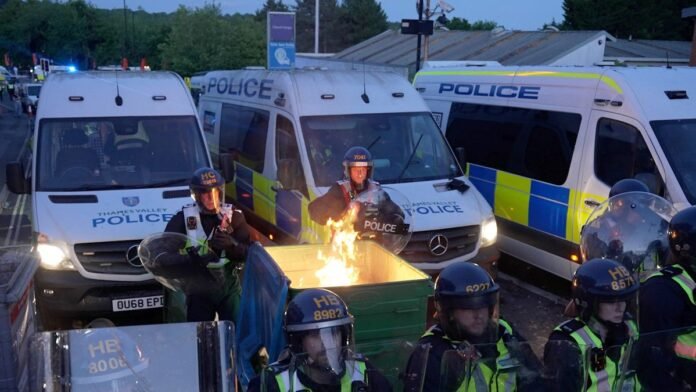

Social media has been described as a volatile environment following recent events such as the Henry Nowak case, according to experts. This week, violent clashes between demonstrators and law enforcement broke out in Southampton after the tragic death of the 18-year-old student, reminiscent of the Southport riots of 2024.
Criticism has been directed at Nigel Farage for his remarks calling for intense anger and alleging disparities in policing following the murder, without condemning the ensuing violence. Keir Starmer accused Farage of exploiting the situation. Experts in online behavior and politics are urging social media platforms to take more decisive measures to prevent the rapid dissemination of contentious or harmful material on their platforms to prevent escalation into real-world conflicts.
Dr. Carolina Are, a digital criminologist at LSE, emphasized that right-wing figures like Farage are leveraging social media algorithms by creating brief, attention-grabbing clips that quickly propagate online. She expressed concern over the rapid spread of such messages online due to their delivery style and potential for repackaging. Algorithms tend to prioritize engaging but controversial content, especially in a politically divided landscape, leading to a highly volatile online atmosphere.
Manuel Tonneau, a social data science researcher at the Oxford Internet Institute, highlighted the issue of social media platforms creating echo chambers that reinforce extreme views and potentially fuel offline aggression. He noted that unmoderated platforms like Telegram could facilitate the coordination of protests, potentially inciting offline violence.
Tonneau pointed out that social media platforms’ business models often incentivize engagement with contentious content, amplifying existing tensions. He stressed that while social media does not create these tensions, it exacerbates and accelerates them, with the platform’s design and business model contributing to the amplification of divisive content.
Research has shown that the Southport riots were fueled by online misinformation and conspiracy theories, including false claims about the attacker’s identity. Home Secretary Shabana Mahmood criticized the circulation of misinformation regarding the Nowak case, which led to real-world consequences such as officers facing threats and having to relocate.
Imran Ahmed, CEO of the Center for Countering Digital Hate, highlighted the role of social media platforms in perpetuating divisive narratives and misinformation, emphasizing the need for swift action to address online harms. He criticized the delay in implementing online safety laws and called for more proactive measures to counter the spread of inflammatory content online.
Ofcom, the media regulator, stated that it was engaging with social media companies regarding the fallout from the Nowak case, ensuring compliance with legal obligations to address criminal content. Failure to adhere to UK regulations could result in substantial fines or service restrictions for tech companies. Under the Online Safety Act, platforms are required to remove illegal or harmful misinformation, especially concerning children.
Police officers sustained injuries during violent protests linked to the Nowak case, prompting an investigation by the police watchdog after the student’s death in police custody. The incident involved a false claim of a racial assault by the perpetrator, Vickrum Digwa, leading to tragic consequences.