
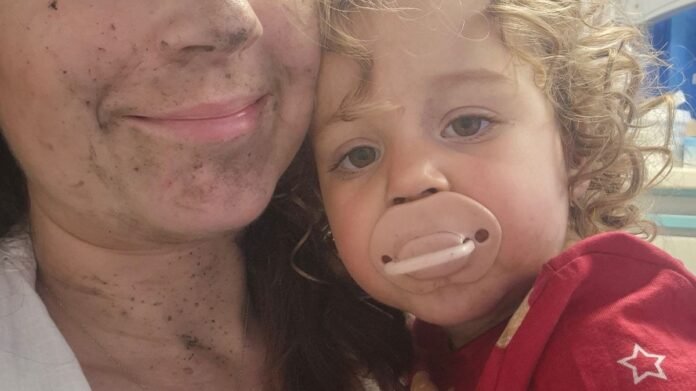

A mother of four is issuing a caution to fellow parents regarding the hazards of a commonly found plant in gardens after her one-year-old daughter suffered poisoning during a family outing.
Daisy Hall’s youngest child, Winnie, inadvertently ingested a rhododendron while seated in her stroller at Attingham Park in Shropshire. Daisy, aged 34, recounted, “I placed her back in the stroller, and when we resumed our walk, she must have picked one and began chewing on it.”
Upon realizing the incident, Daisy researched online and learned that the flower is extremely toxic to humans. She promptly took Winnie to the hospital, where doctors administered activated charcoal mixed with water to prevent the absorption of the poison into the body.
The toddler underwent monitoring with an ECG for six hours before being discharged. Subsequently, she was kept under observation at home for an additional 24 hours. Rhododendrons contain toxins known as grayanotoxins, which can pose risks to both humans and animals upon ingestion, manifesting symptoms such as nausea, dizziness, vertigo, blurred vision, and vomiting.
Fortunately, Daisy had recently developed an interest in gardening and realized the importance of plant identification. She sought advice from her mother, Debbie, a 63-year-old nurse, before contacting NHS 111 en route to the hospital.
Daisy remarked, “If I had waited for an ambulance, she would likely have surpassed the charcoal’s effective timeframe.”
Upon arrival at the hospital, they received prompt attention and administered charcoal. Daisy explained, “The charcoal must be given within an hour to prevent the poison from being absorbed. It was challenging to administer the charcoal, hence the black stains on us.”
Thankfully, Winnie fully recovered. Daisy expressed, “She was completely fine.” Following her online disclosure of the incident, Daisy’s warning has garnered over 7.1 million views.
She stated, “Online users have commented that they wouldn’t have thought to check and it has changed their approach to not simply removing the plant from their child’s mouth but to research it. People have shared information on other poisonous plants, leading to widespread learning.”
For convenient access to valued news, select Daily Mirror as a ‘Preferred Source’ on Google News.