
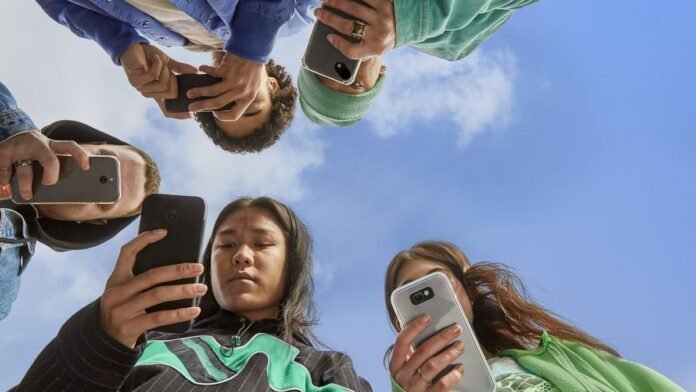

Keir Starmer is set to reveal a prohibition on social media use for individuals under 16 on Monday as part of a significant set of online safety actions aimed at safeguarding young people.
The Prime Minister will commit to challenging the tech giants and ending a system that is failing children, according to reports.
In a statement on Sunday evening, Mr. Starmer expressed, “The issue of ensuring children’s online safety is a major topic of our era. As a parent myself, I understand that every parent desires their child to grow up secure and content.”
He added, “This decision is about choosing a side: supporting families nationwide or upholding a status quo that is ineffective. People rightfully anticipate action, and this administration will consistently advocate for parents and prioritize children.”
Pressure has risen on Keir Starmer to take decisive action on online safety following Australia’s implementation of a social media ban for individuals under 16 last December.
Australia’s eSafety Commissioner incorporated ten platforms, including Facebook, Instagram, Snapchat, TikTok, YouTube, Threads, Reddit, Kick, and Twitch, within the age restrictions. It is anticipated that a similar ban in the UK would encompass major social media platforms and pertain to individuals under 16.
The UK has already enforced stringent age verification protocols across social media platforms since the enactment of the Online Safety Act in July of last year. Presently, the minimum age requirement for most platforms stands at 13.
Ofcom, the UK’s media regulator, suggests various methods to verify one’s age, such as utilizing technology to analyze photos or videos, employing open banking or credit card checks, or confirming age through mobile network operators.
However, research indicates challenges with age verification in the UK, similar to findings in Australia. A study revealed that young people circumvent age checks through methods like fake birthdays, shared accounts, altered photos, and even using false disguises. Nearly half of children (46%) believe age verification is easily evaded, as per data from the Internet Matters survey last month.
Technology Secretary Liz Kendall acknowledged the need to learn lessons from Australia regarding age verification measures.
The UK’s plan is anticipated to surpass Australia’s approach by extending restrictions to gaming platforms and AI chatbots. Additionally, measures will be introduced to limit excessive social media use among 16- and 17-year-olds and prevent abrupt changes once children reach the age of 16.
Implementing a ban will necessitate legislative action, and while parents await its enforcement, powers under the Children’s Wellbeing and Schools Act empower the Government to introduce new online safety measures without fresh primary legislation.
Secondary legislation, which expedites the process, will be utilized. Members of Parliament and peers will still have the opportunity to deliberate and vote on the matter. Ms. Kendall aims for the legislation for a ban to be passed by the year’s end, after which Ofcom will likely require time to enforce the ban effectively.
A change in Labour leadership could potentially alter the timeline.
The proposed measures will be unveiled by the Prime Minister on Monday following a consultation period that concluded on May 26.
The specific social media companies that will face a ban remain undisclosed, but it is expected that the UK will follow Australia’s lead in restricting access to prominent platforms like TikTok, Facebook, Instagram, YouTube, Reddit, and Snapchat.
The UK’s initiatives are projected to go beyond Australia by including AI chatbots and gaming platforms in the restrictions, alongside introducing controls on social media usage for 16- and 17-year-olds to limit late-night browsing.
Culture Secretary Lisa Nandy emphasized that merely banning social media is not a complete solution but acknowledged its significant role, drawing on Australia’s example. She suggested that a ban may not prevent all young people from accessing social media but could alter the assumption that children as young as eight or nine are emotionally equipped to navigate it simply because their peers are online.
“I believe banning social media alone isn’t the ultimate solution, yet Australia has demonstrated its substantial impact,” said Ms. Nandy, underscoring the need for a comprehensive approach.
She disagreed with Ian Russell, a bereaved father who opposes a ban and advocates for a broader strategy to combat online harms.
Mr. Russell, whose daughter’s tragic experience prompted his concerns, lamented feeling let down by Mr. Starmer for choosing what he perceives as a less effective route over long-term social media safety improvements.
The majority of parents responding to the Government’s online safety consultation called for age limits akin to Australia’s model. Over six in 10 young individuals expressed that restricting risky features would enhance their sense of security, although concerns about feeling excluded if restrictions were imposed were also prevalent.
Other grieving parents strongly support a ban. Ellen Roome, who believes her son’s death was linked to an online challenge, criticized lawmakers for rejecting a ban on social media for under 16s.
Lord Nash, a Tory peer advocating for a ban, emphasized the government’s opportunity to prioritize children’s safety and enforce age restrictions effectively.