
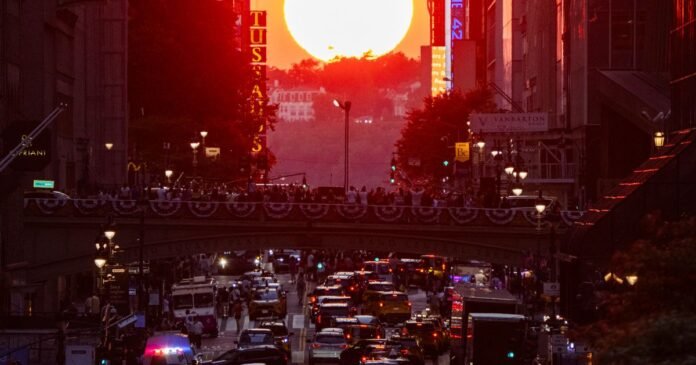

Crowds of New Yorkers and visitors filled the city’s streets to witness the magnificent sunset perfectly aligning between Manhattan’s towering skyscrapers. Stunning images captured the radiant orange sun framed by the iconic grid of buildings as numerous individuals paused to snap photos and record videos of this rare occurrence. Known as Manhattanhenge, this phenomenon happens just four times a year when the setting sun lines up with the east-west streets of the borough due to Manhattan’s unique street layout angle.
Named by astrophysicist Neil deGrasse Tyson after England’s Stonehenge, Manhattanhenge made its final summer appearance on July 12, drawing attention as part of a series of dramatic sunsets across the city before concluding for the season. In the upcoming month, New Yorkers can anticipate another celestial event as a partial solar eclipse will be visible in the city on August 12.
The setting sun, framed by Manhattan’s towering buildings, marked the return of Manhattanhenge for its last summer showing. This extraordinary sight attracted crowds across New York, with the massive orange sun perfectly centered by the city’s east-west streets.
The unique alignment of Manhattanhenge is a result of the borough’s street grid being oriented around 30 degrees east of true north, leading to the sun aligning with the streets on only four evenings annually. The event, reminiscent of England’s Stonehenge, represents a special solar alignment. The display on July 12 signified the final full sunset alignment of the summer before the event reoccurs later in the year.
Numerous onlookers paused to witness the breathtaking sunset, many capturing the fleeting moment with their phones. Tourists and locals lined the streets as the radiant sun descended amid the famous skyline, creating a highly photographed natural spectacle in New York. Manhattanhenge has become a yearly tradition for many, attracting photography enthusiasts, social media creators, and astronomy fans eager to seize the perfect shot. The display lasted briefly before the sun disappeared below the horizon, concluding another summer Manhattanhenge event.
Despite occurring near the summer solstice, Manhattanhenge did not coincide with the longest day of the year. Instead, the event was a result of Manhattan’s rotated street grid rather than a direct north-south alignment. The gradual shift in the sun’s position along the horizon as the Earth orbited the sun led to the perfect alignment with the city’s streets. While Manhattanhenge typically features four sunset alignments annually, the broader visual impact extended over several weeks.
This year’s summer phenomenon began before July and culminated with the final alignment on Sunday. The extended display provided ample opportunities for photographers to capture striking images of sunlight streaming between the skyscrapers, even beyond the specific alignment dates.
Skywatchers will soon anticipate another celestial event as a partial solar eclipse is set to occur on August 12 in New York. The eclipse, visible across North America and Europe, will see the moon covering approximately 10% of the sun from the city’s perspective. Eclipse glasses will remain essential throughout the event in New York, as the sun will not be completely obscured.
For those who missed the summer spectacle, another opportunity awaits later in the year with the return of Reverse Manhattanhenge. This winter edition, unlike the traditional event focusing on stunning sunsets, will showcase the rising sun illuminating Manhattan’s streets at dawn, offering spectators another chance to capture the city’s famous skyline bathed in golden light.