
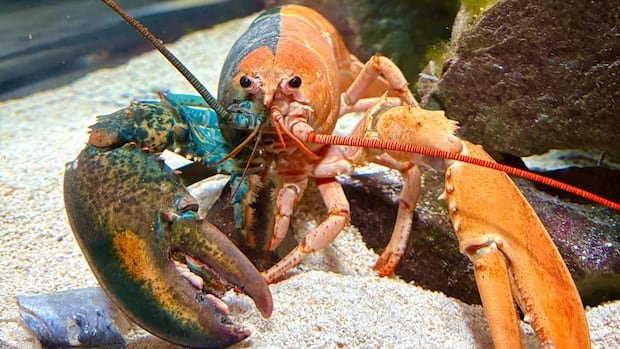

In his four-decade career as a lobster fisherman, Robert Wagner encountered an extraordinary sight – a lobster with a unique split coloration, half blue and half orange from head to tail. Wagner, astonished by the discovery, named the lobster Oscar and felt fortunate to have come across such a rare creature.
Oscar was found in one of the last traps pulled from the waters near Blue Rocks on Nova Scotia’s South Shore. Intrigued by Oscar’s appearance, Wagner’s daughter suggested contacting Dalhousie University to offer the lobster for study and preservation.
Nadia Stewart, from Dalhousie’s Beaty Centre for Marine Biodiversity, expressed gratitude for the opportunity to care for Oscar, highlighting the vulnerability of such distinct-colored lobsters in the wild due to predation. Stewart explained that lobsters like Oscar, with two different sets of genetic information resulting from a rare mutation, occur in about one out of every 50 million lobsters.
After a month of tender care from Wagner and his family, Oscar was transported to Dalhousie University’s facility in Halifax. The transfer required a special license, ensuring the lobster’s safe relocation and continued well-being.
Stewart shared that Oscar has adapted well to his new environment, surprising staff by shedding his shell recently. The old blue-orange shell was put on display, and Oscar was given time to recover from molting. Once his new shell hardens, which typically takes 14 to 30 days, Oscar will return to public view, showcasing his distinctive blue and orange coloration.
Wagner expressed satisfaction with the decision to donate Oscar, stating, “We’re just grateful that it got in the right hands and hope [Oscar] has a good life.”