

Klaus Koehler, an avid plant enthusiast, made a rare discovery while exploring Sylvia Grinnell Territorial Park near Iqaluit in July. He stumbled upon a plant species not commonly found in the Arctic, raising concerns about the potential spread of invasive species in Northern regions due to climate change.
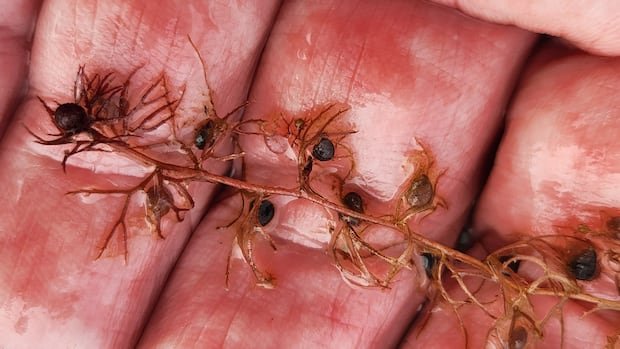
During his stroll, Koehler reached into a pond and retrieved a peculiar brownish plant known as bladderwort. Although inconspicuous to the untrained eye, Koehler recognized this unique plant by its distinctive features.
The carnivorous bladderwort plant is adorned with small black bladders containing partially digested flies. Typically thriving in more temperate climates, this insect-eating species seldom ventures into the tundra environment.
The last documented sighting of bladderwort in the area dates back to 2012 when a team of scientists discovered samples near Kimmirut, approximately 120 kilometers southwest of Iqaluit. This discovery was documented in the scientific journal Phytokeys.
Koehler’s observation hints at a shifting climate scenario, where the warming Arctic may facilitate the migration of plant species not traditionally found in the region. The gradual rise in temperatures could lead to an alteration in the Arctic ecosystem, with the potential influx of both invasive and native plants.
Paul Sokoloff, a senior research assistant at Ottawa’s Museum of Nature, shares concerns about the introduction of non-native species into Arctic ecosystems. External factors like birds, cargo ships, and human activity may inadvertently transport plant seeds, disrupting the delicate balance of native flora.
While Koehler’s finding may not pose an immediate threat, Sokoloff highlights the broader implications of invasive species encroaching on Arctic territories. Studies suggest that numerous plant species could potentially invade the Arctic, posing a risk to indigenous flora.
To further study the bladderwort specimen from Iqaluit, Koehler plans to submit a sample to the Museum of Nature. This collaborative effort aims to enhance scientific understanding of the plant’s northward expansion and its ecological implications.