
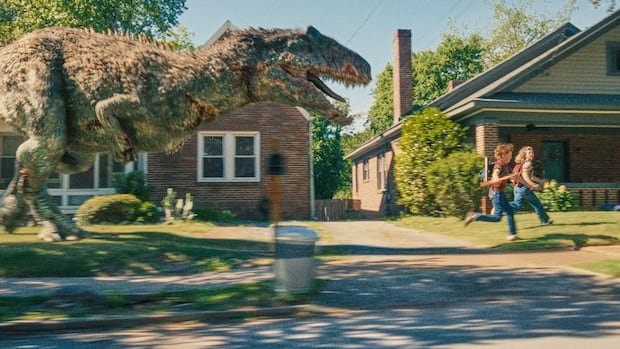

A massive serpent-like entity emerges from a nearby pool, while feathered reptiles pursue a family down their driveway. Two colossal, furry creatures lean against a house and engage in copulation in “The End of Oak Street,” the latest film to hit theaters, riding on the coattails of dinosaurs and a nostalgic admiration for “Jurassic Park.”
In contrast to previous Hollywood portrayals, the prehistoric creatures in this film differ significantly, reflecting a much-anticipated revision from the viewpoint of paleontologists. Experts were consulted by CBC News to discuss the accuracy of the feathers and fauna depicted in the movie, as well as where filmmakers have taken creative liberties to fill gaps in the incomplete fossil record that still leaves fundamental questions unanswered.
But the burning question remains – is that really how dinosaurs mated?
From a scientific perspective, the sight of numerous dinosaurs adorned with feathers and fluff in the movie was a welcomed change, as it deviates from the traditional portrayal seen even in recent “Jurassic World” films, according to Victoria Arbour, a paleontologist at the Royal B.C. Museum.
The depiction of dinosaurs in Hollywood has long been behind the scientific understanding. The close relationship between dinosaurs and birds has been suspected since the early days of the theory of evolution. Fossil discoveries since the 1990s have greatly expanded the evidence supporting the belief that many non-avian dinosaurs possessed feathers.
One significant discovery was Sinosauropteryx prima in China, which provided clear evidence of feathers on a non-avian dinosaur for the first time. These discoveries have revolutionized the way dinosaurs are perceived by scientists, a shift that has been hindered in popular culture by movies featuring scaly creatures inspired by “Jurassic Park.”
In “The End of Oak Street,” the portrayal of dinosaurs with feathers is more prominent than in most other dinosaur movies. The choice to depict the feathered Allosaurus and a smaller feathered creature resembling a velociraptor was considered plausible by experts due to their evolutionary proximity to birds.
While some animals in the movie were inspired by real prehistoric creatures, others were more creatively imagined. The depiction of a giant legless aquatic creature resembled the ancient snake Titanoboa or modern-day caecilians, but such a creature has no known counterpart in the fossil record, as confirmed by Arbour’s statement.
The film also introduces artistic interpretations of sauropods, which may not have been as furry in reality due to their large size. The depiction of these creatures mating in the film, although somewhat bizarre given their immense size, was explained by director David Robert Mitchell as an attempt to show that dinosaurs had complex lives beyond hunting.
Understanding the mating behaviors of dinosaurs remains a challenge for scientists due to the scarcity of soft tissue preservation in fossils. Despite significant advancements, many aspects of dinosaur mating behaviors are still shrouded in mystery, as behaviors do not fossilize well. The depiction in “The End of Oak Street” was considered by experts as not crossing the line from uncertainty to impossibility, given the limited knowledge available.
The film presents a blend of scientific accuracy and creative interpretation, sparking discussions among experts about the portrayal of dinosaurs in popular culture and the ongoing quest to unravel the mysteries of dinosaur behaviors.