
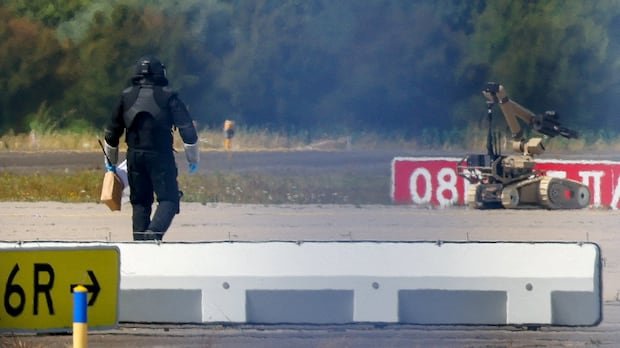

German authorities are examining a drone equipped with explosives and a detonator discovered at Leipzig airport, while Russian Foreign Minister Sergey Lavrov has indicated Moscow’s intention to increase retaliation against countries aiding Ukraine.
In an interview with VGTRK, Russia’s state media, Lavrov stated, “We will employ more severe measures to dismantle everything that supports the West in bolstering Kyiv’s war capabilities. We are already taking action.”
The drone, containing an unidentified explosive device, was found by an airport worker in the security area of the cargo operations zone near the south runway of Leipzig airport, which is classified as “critical infrastructure.” Leipzig serves as a key NATO airport for transporting armaments, ammunition, weapons, and other military supplies to Ukraine through flights operated by Ukrainian cargo firms.
The presence of the drone, positioned next to one of the Ukrainian cargo planes, represents a heightened level of threat for Germany, as mentioned by the country’s interior minister. Alexander Dobrindt described the incident as part of a sophisticated “professional hybrid threat scenario” rather than the work of amateurs.
While German authorities are investigating the incident and have not disclosed the drone’s origin, U.S. intelligence officials informed the Wall Street Journal that intelligence reports suggest the drone likely belonged to the Russian government.
Berlin is approaching the situation cautiously, enhancing anti-drone capabilities and refraining from premature accusations. Dobrindt emphasized the ongoing investigative phase, stating, “We are currently in the process of gathering information, and it would be premature for a federal minister to comment at this stage.”
Officials have cautioned about Russia’s utilization of drones, espionage, sabotage, and influence operations across Europe, particularly in the lead-up to upcoming regional elections in Germany. Dobrindt highlighted the evolving threat landscape, emphasizing the daily challenges faced by Germany.
Hybrid warfare tactics, including espionage, sabotage, cyber attacks, and covert actions by foreign entities, are regularly targeting Germany, according to Dobrindt. Recent incidents include the thwarting of a Russian plot to assassinate the CEO of a German defense contractor and the arrest of an individual suspected of spying for Russia.
The Institute for Strategic Dialogue (ISD) has been monitoring Russian interference in Germany through online campaigns aimed at destabilizing democracies and undermining Ukraine’s war efforts. Dobrindt acknowledged the attempts to influence German politics and society, especially during regional elections.
Hans-Jakob Schindler, from the Counter Extremism Project, characterized the drone incident in Leipzig as an aggressive escalation of Russian interference, posing critical questions about the threshold between defense and direct conflict. The increasing use of physical tactics underscores the urgent need to address these provocations and set clear boundaries against such aggression.
Schindler noted Lavrov’s remarks as a departure from Russia’s previous denials of interference in Western nations, signaling a more aggressive stance against Europe, the West, and NATO.