
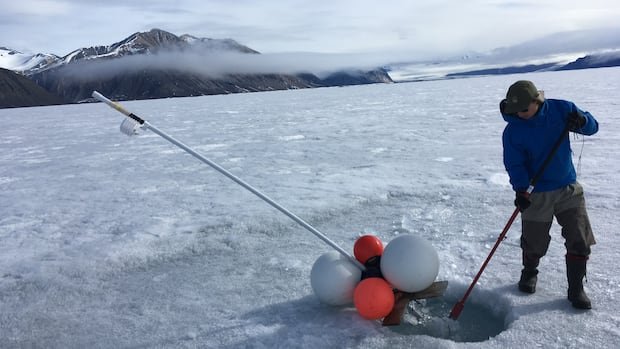

In a recent study, scientists have confirmed the disappearance of Canada’s last remaining epishelf lake, which was a unique freshwater body floating on saltwater and supported a distinct ecosystem. Jérémie Bonneau, an assistant professor at Laval University in Quebec City and the lead author of the study, expressed sadness over the loss of the Milne Fiord epishelf lake on Ellesmere Island in Nunavut, emphasizing its significance as the final such formation in Canada.
The study, recently published in the journal Scientific Reports, delves into the process that led to the lake’s demise and highlights the role of climate change in transforming the Arctic region. The irreversible loss of the epishelf lake marks the end of a 4000-year era and signifies a significant shift in the ecological landscape.
Epishelf lakes form unique ecosystems due to their freshwater layer floating on denser saltwater. The Milne Fiord lake, dammed by the Milne Ice Shelf for millennia, accumulated freshwater over thousands of years, creating a distinct habitat. Researchers discovered separate communities of bacteria, viruses, and phytoplankton in the freshwater and saltwater layers, indicating a rare coexistence of two ecosystems within the same body of water.
The collapse of the Milne Ice Shelf in 2020 led to the disappearance of the epishelf lake, as the barrier that held the freshwater in place was no longer intact. The study details the rapid drainage of the freshwater following the ice shelf collapse, resulting in the loss of the unique habitat and its inhabitants. While epishelf lakes have vanished from Canada, similar formations still exist in Greenland and Antarctica, though researchers warn of their uncertain future in the face of ongoing environmental changes.