
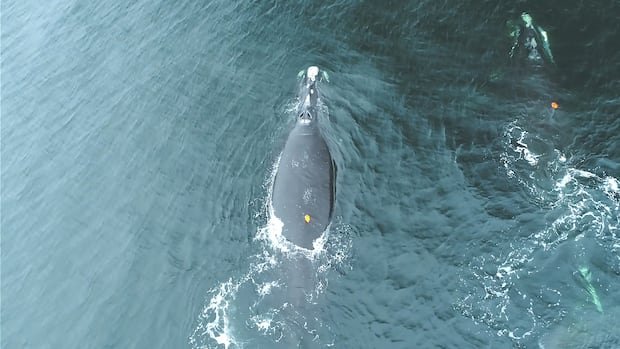

A recent research study has revealed that critically endangered North Atlantic right whales are engaging in nighttime surface feeding, which puts them at a higher risk of boat collisions. The study, recently published in the peer-reviewed journal PLOS One, highlights this behavior as a potential threat to the whales and emphasizes the need for preventive measures.
The study was conducted by Jay Kirkham, a PhD student at Dalhousie University in Halifax, in collaboration with the U.S.-based non-profit Ocean Alliance. Kirkham and his team tagged 23 right whales in the Shediac Valley, a subsea valley in the southern Gulf of St. Lawrence, where a portion of the North Atlantic right whale population, estimated at around 384 whales, congregates during the summer months.
The tagged whales were monitored for their feeding behavior using video footage and data tracking their movements and swimming directions. Kirkham observed that right whales exhibit distinct feeding patterns during the day, characterized by the whales using their mouths as a braking mechanism, requiring them to increase tail movements to compensate for the slowdown.
Utilizing the video data, Kirkham trained a machine learning algorithm to identify nighttime feeding behavior when visual identification was not feasible. The findings indicated that right whales feed at the same depth as large vessels at night, heightening the risk of collisions.
Although right whales typically feed near the sea floor during the day, they adjust their feeding habits at night to follow their prey, zooplankton, higher up in the water column. This behavior leads to potential overlap with passing ships, increasing the likelihood of collisions and entanglements in fishing gear.
Collisions with vessels and fishing gear entanglements are major contributors to right whale mortality. The study aims to inform conservation efforts and protective measures for the endangered species, with government bodies like Transport Canada and Fisheries and Oceans Canada playing crucial roles in overseeing conservation initiatives.
Fisheries and Oceans Canada emphasized its focus on preventing whale entanglements and enforcing fishing closures, while Transport Canada implements speed restrictions and vessel exclusion zones in critical whale habitats. However, Kirkham noted that a significant portion of the tagged whales ventured outside the protected zones, exposing them to ship traffic.
Transport Canada highlighted its surveillance program, which uses visual and audio detection tools to safeguard whales from collisions. The department stressed the importance of employing advanced technologies and scientific research to enhance whale protection measures and mitigate the risks posed by maritime activities.