
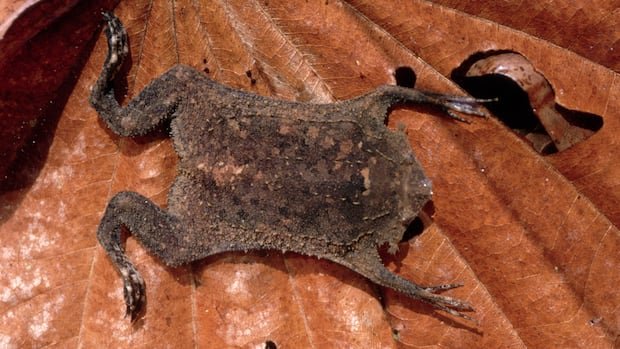

In a remarkable discovery, researchers in California have unraveled a fascinating ability of the Surinam toad, known for its peculiar characteristics, to essentially “see” with its fingertips. Despite being nearly blind and tongueless, this flat-bodied amphibian excels as a skilled hunter in the murky waters of the Amazon basin.
The toad, with its unique triangular head and tiny eyes, appears inconspicuous like a dead leaf on the sea floor. However, its hunting prowess has long intrigued scientists due to its ability to swiftly detect and capture prey, such as fish, in a matter of milliseconds.
A recent study led by neurobiologist Duncan Leitch from the University of California, Los Angeles, shed light on this mystery. The research revealed that the Surinam toad, also known as the star-fingered toad, relies on its star-shaped fingertip lobes to sense the subtle movements of water generated by nearby prey.
These highly sensitive touch organs, akin to the fovea in the human eye, enable the toad to gauge the size and proximity of potential prey without direct contact. With 128 tiny lobes on its fingertips, equipped with numerous touch-sensitive nerves, the toad can swiftly launch its suction feeding mechanism to capture unsuspecting prey.
The study also highlighted the disproportionate brain allocation for processing sensory information from the fingertips, a strategy previously associated with more complex mammal brains. This intriguing finding suggests a convergence in evolutionary solutions between frogs and mammals, despite their separate evolutionary paths spanning over 350 million years.
Lea Randall from the Wilder Institute in Calgary emphasized the significance of this discovery in understanding vertebrate evolution and brain utilization strategies. The research opens new avenues for exploring sensory adaptations in lower vertebrates and sheds light on the evolutionary mechanisms underlying sensory processing in amphibians.
This groundbreaking study not only unveils the remarkable sensory capabilities of the Surinam toad but also offers valuable insights into the evolutionary adaptations of vertebrates across diverse species.