
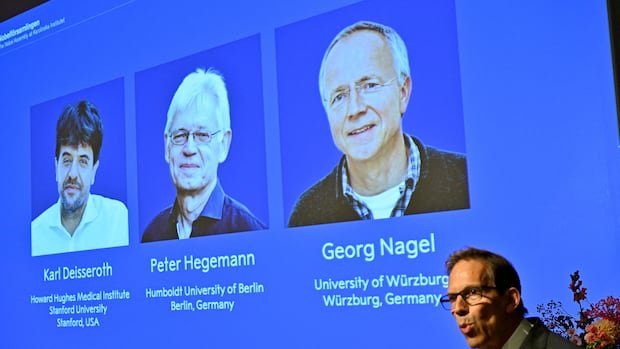

Karl Deisseroth, Peter Hegemann, and Georg Nagel were awarded the 2026 Nobel Prize in Physiology or Medicine for their contributions to light-gated ion channels and optogenetics, announced the Nobel Assembly at Karolinska Institutet in Stockholm. Optogenetics enables the manipulation of individual nerve cell activity in a living brain, unlocking new insights into brain function globally. The trio, comprising Deisseroth from Stanford University, Hegemann from Humboldt University, and Nagel from the University of Würzburg, expressed gratitude for the honor and camaraderie of sharing the prestigious award.
The Nobel Prize, worth 12 million Swedish crowns ($1.7 million Cdn), will be split among the three scientists. Their groundbreaking work has paved the way for transformative advancements in neuroscience by elucidating how the brain processes information and coordinates neuron interactions. In ongoing clinical trials, optogenetics shows promise in restoring vision for individuals with retinitis pigmentosa and enhancing cochlear implants for more precise auditory nerve stimulation.
Hegemann’s and Nagel’s pioneering research in the 1990s led to the discovery of channelrhodopsin-2, an ion channel activated by light. Deisseroth later demonstrated the application of this protein in generating electrical impulses in nerve cells, terming the technique as optogenetics. Their collaborative efforts and shared discoveries underscore the profound impact of their work on neuroscientific understanding.
The Nobel Prizes ceremony, which commenced with the Physiology or Medicine award, will continue with accolades in chemistry and physics, literature, peace, and economics. Alfred Nobel, the prize’s founder, bequeathed his estate to recognize individuals or groups contributing significantly to humanity’s welfare. The laureates will receive their prestigious awards on December 10, commemorating Nobel’s legacy as a visionary inventor and benefactor.