
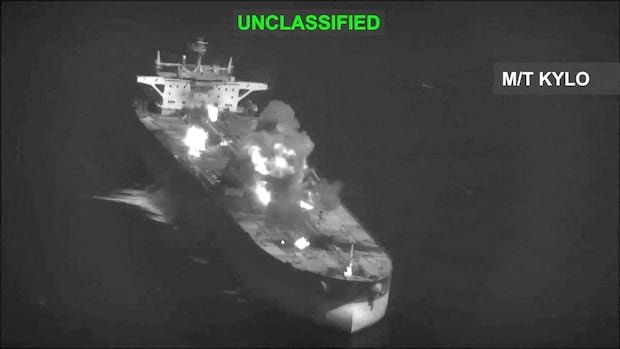

U.S. military forces have carried out strikes on three Iranian oil tankers in response to ballistic missile attacks on Navy warships, as per a statement released by American military officials on Saturday. The military warned of the possibility of destroying Iran’s vulnerable oil fleet if deemed necessary. This development has been described by experts as a perilous escalation following previous Iranian assaults on commercial shipping in the region.
The recent strikes, occurring shortly after President Donald Trump downplayed the conflict as insignificant, mark a renewed shift towards combat following a six-month period of intermittent hostilities that commenced with attacks on Iran by the U.S. and Israel on February 28. Both sides have been engaged in efforts to inflict military and economic harm on each other, culminating in the breakdown of negotiations.
According to the military’s announcement, a U.S. aircraft carrier and destroyer successfully evaded multiple unprovoked Iranian assaults while on patrol in the area, resulting in no injuries to American personnel. The statement indicated that two Iranian oil tankers were rendered inoperable, while a third, which was empty, was destroyed.
In response to these events, Iran’s state broadcaster reported that Iran retaliated by targeting three oil tankers and three American vessels in response to the U.S. strikes, although this information could not be immediately verified. A spokesperson from Iran’s joint military command issued a warning, stating that any further interference with Iranian shipping by the U.S. would lead to more severe strikes against American military ships.
The U.S. Central Command’s Admiral Brad Cooper emphasized the country’s commitment to defending its forces and reiterated the readiness to eliminate Iran’s exposed oil fleet if required. In contrast, Iran’s Foreign Ministry condemned the attacks as war crimes and shifted the responsibility for any repercussions resulting from continued U.S. aggression, including economic warfare, onto Washington and its allies.
The recent hostilities come in the wake of renewed confrontations between the U.S. and Iran, following a period of relative calm, with the resumption of attacks targeting the Strait of Hormuz and Iranian communities along the waterway. Earlier in the week, a U.S. bombardment in southern Iran resulted in the deaths of at least five individuals, including individuals attending a wedding ceremony.
The ongoing conflict has been exacerbated by the U.S.’s renewed efforts to impose economic sanctions on Iran, prompting Tehran’s senior leaders to adopt a more defiant stance in the face of sustained pressure. Despite Iran’s attempts to navigate around sanctions and a U.S. blockade of its ports to facilitate oil exports, uncertainties persist regarding the extent of targeting on Iranian oil tankers amid the ongoing crisis.
Diplomatic efforts to address the root cause of the conflict, Iran’s nuclear program, have faltered following the breakdown of negotiations after a memorandum of understanding was signed between the U.S. and Iran in mid-June. Currently, the U.S., Britain, France, and Germany are considering referring Iran to the U.N. Security Council for alleged non-compliance with nuclear nonproliferation commitments. Meanwhile, Tehran’s strategic focus has shifted towards controlling the vital Strait of Hormuz, a critical passageway for global oil and natural gas shipments, which has become a focal point in the ongoing tensions.