
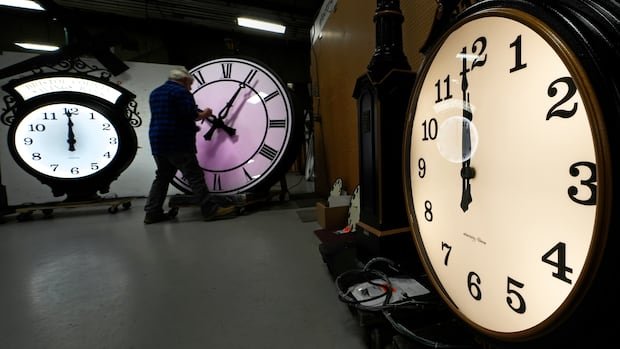

In a major decision made in France, an international timekeeping body recently voted to eliminate leap seconds after over 50 years of using them to maintain synchronization between our clocks and the Earth’s rotation. This move will allow the clocks to gradually drift out of alignment by a full hour over centuries or even millennia.
The precise atomic time, established in the 1950s using atomic vibrations, differs slightly from solar time, which is based on the sun’s position in relation to a specific Earth location due to the gradual slowdown of the planet’s rotation. Leap seconds were introduced in 1972 to address this discrepancy, with an initial addition of ten seconds. Since then, the International Earth Rotation and Reference Systems Service has been monitoring the gap between solar and atomic time to determine when to insert an extra second, typically at the end of December or June. Leap seconds have been added 27 times, with the most recent in 2016.
Without these adjustments, noticeable changes would not occur in our lifetimes. However, over time, the brightest part of the day might shift to midnight, and the darkest part to noon. Similar to leap years adding days to February every four years to align the Gregorian calendar with the seasons, leap seconds ensure the proper alignment of timekeeping systems.
While leap seconds have served their purpose, they are now causing more challenges than benefits. The consensus is to eliminate these abrupt adjustments due to the difficulties they pose for technology and telecommunications companies reliant on precise timekeeping. Various companies implement leap seconds differently, potentially leading to system failures. Instances such as Reddit and LinkedIn crashes in 2012 and brief outages at Cloudflare in 2016 have been attributed to leap seconds.
The possibility of a “negative leap second,” where a second would be subtracted, arises as the Earth’s rotation has accelerated in recent years. However, this change could have significant adverse effects on software and hardware infrastructures. To address these concerns, the decision was made to accumulate the extra seconds until they reach 3,600, equivalent to an hour, before adjusting the clocks. This adjustment is set to take effect in May 2027.
Despite the challenges posed by leap seconds, there is no perfect solution to account for the Earth’s changing rotation speed. As Associate Professor Samantha Lawler notes, the complexity of factors affecting the Earth’s rotation makes it challenging to devise a flawless system. Ultimately, accepting a margin of error in timekeeping remains an ongoing human dilemma.