

A human rights organization has stated that the Israeli government is moving forward with a divisive settlement expansion initiative that would effectively split the occupied West Bank, a plan that has faced extensive criticism as a danger to the feasibility of a future Palestinian state.
On Wednesday, the Israeli rights group Ir Amim announced that the government would begin bidding for an additional 2,167 housing units in a settlement project that would effectively divide the West Bank into two parts.
The new tender for 2,167 units is in addition to an earlier one for 1,234 units announced at the end of August, which triples the total number of housing units to 3,401, as stated by the group.
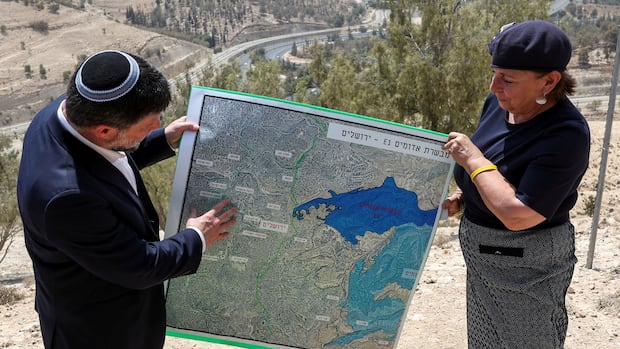
The settlement development in the E1 area, located east of Jerusalem, is particularly controversial because it extends from the city’s outskirts deep into the occupied West Bank. This development would bisect the West Bank and sever its connection to East Jerusalem, fragmenting the territory that Palestinians envision as part of their future state.
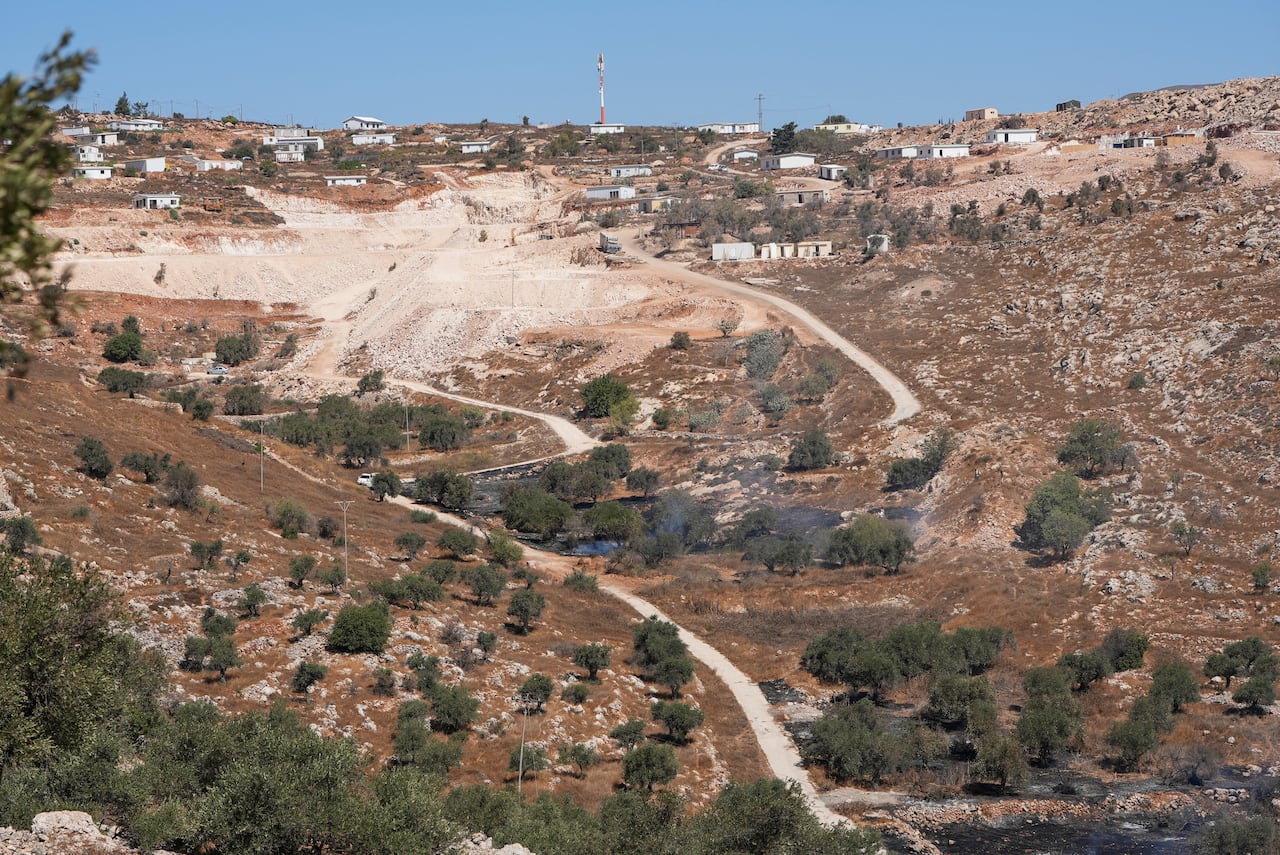
An Israeli settlement is visible as smoke rises from burning olive groves, which Palestinians claim were ignited by Israeli militant settlers, in Burqa in the Israeli-occupied West Bank on Thursday. (Ali Sawafta/Reuters)
The United Nations, along with most nations, considers these settlements illegal under Article 49 of the Fourth Geneva Convention, which addresses military occupations. Israel disputes this designation, referring to the area as “disputed” rather than occupied.
The E1 initiative has been under consideration for over twenty years but was put on hold due to pressure from the U.S. during previous administrations.
-
U.S. ambassador visits Palestinian town amid rise in occupied West Bank settler violence
-
Canada, U.K., France to ban trade of goods from Israeli settlements in occupied West Bank
A representative for Palestinian President Mahmoud Abbas has denounced the new housing units as a breach of international law.
Israel has not officially acknowledged the tender announcements. The office of Prime Minister Benjamin Netanyahu did not respond to a request for comment.
Israeli Finance Minister Bezalel Smotrich, an ultra-nationalist member of the ruling right-wing coalition, claimed that the initiative would “bury” the prospect of a Palestinian state. Smotrich, who faces accusations of promoting “extremist rhetoric,” is sanctioned by Canada and other nations for “inciting violence against Palestinians in the West Bank,” advocating for their removal to facilitate the expansion of Israeli settlements.
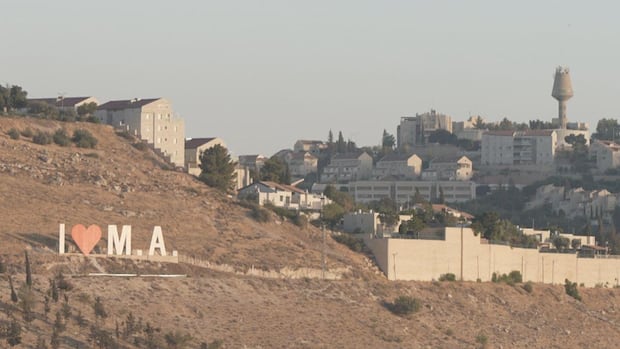
The Israeli government has granted final approval to a contentious settlement construction initiative that would effectively divide the occupied West Bank into two segments. Such settlements are deemed illegal under international law.
Bidding to open days before elections
The bidding process is set to commence on October 25, just two days prior to Israel’s scheduled parliamentary elections.
The right-wing coalition government in Israel has sanctioned a substantial expansion of settlements in the West Bank.
Ir Amim indicated that the bidding timeline exemplifies the government’s determination to advance the settlement project and “establish an increasingly irreversible reality on the ground ahead of the elections.”
This announcement follows a recent decision by Canada, Britain, and France to prohibit exports from Israeli settlements in the West Bank.
Netanyahu’s conduct in relation to the Hamas-led attack on October 7, 2023, is a significant topic in the current election campaign.
The prime minister has faced increasing criticism for dismissing calls for an official government inquiry into the events surrounding the October 7 attacks. Last week, Israeli newspaper Haaretz reported that Netanyahu had received direct warnings from the U.A.E. regarding Hamas’s planned major offensive just days before the attack, to which Netanyahu’s office responded by labeling the report as an “absolute lie.”
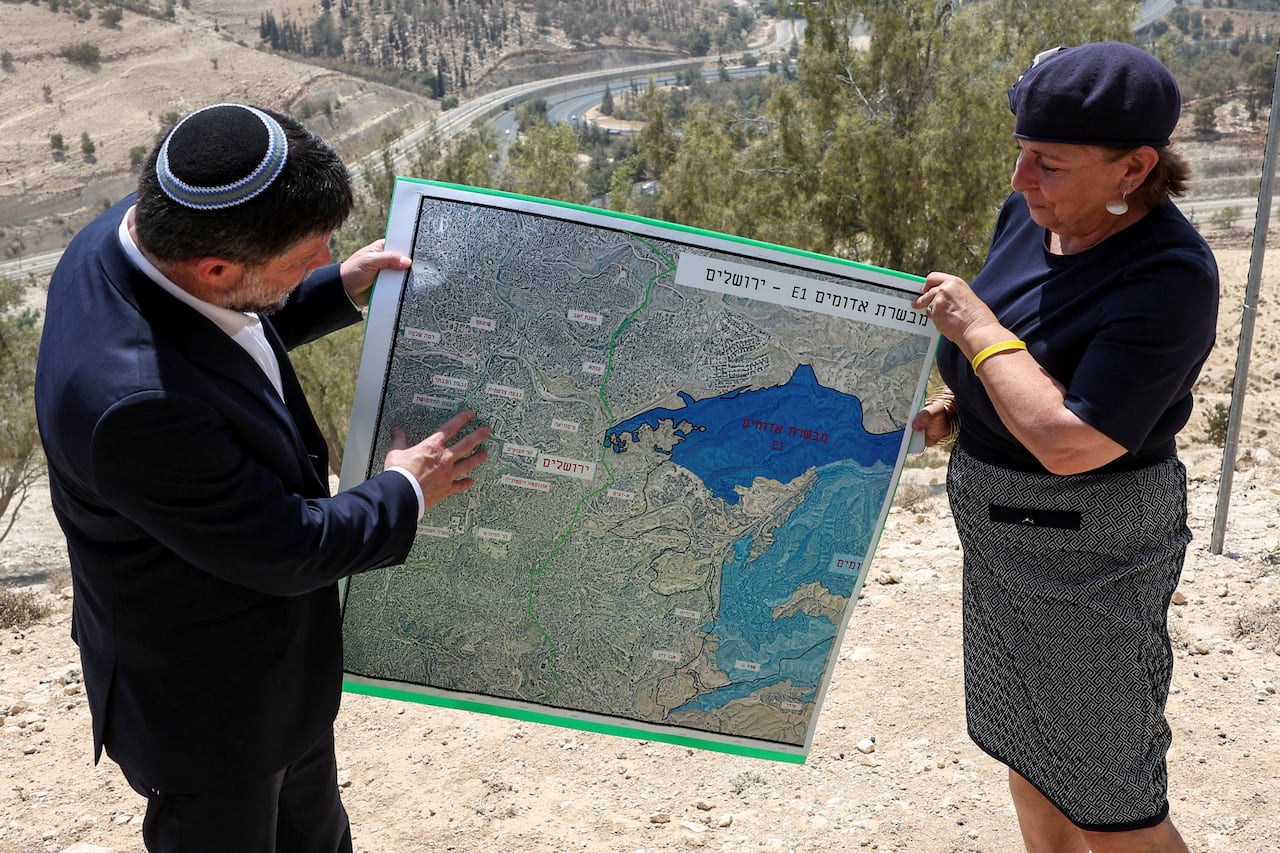
Israeli Finance Minister Bezalel Smotrich and a woman display a map depicting the E1 settlement plan during a news conference near the Israeli settlement of Maale Adumim, in the Israeli-occupied West Bank, on August 14, 2025. (Ronen Zvulun/Reuters)
Peace Now, an organization that monitors settlement growth in the West Bank, stated that the project is “dangerous for the future of Israel and for any potential for a peaceful two-state resolution,” ensuring prolonged violence.
Last month, British Foreign Secretary Ed Miliband criticized Israel’s initiation of a tender for the E1 project.
Miliband stated, “The consequences of settler violence and terrorism have been devastating for Palestinian communities. The expansion of settlements and efforts to create irreversible divisions on the ground jeopardize peace, security, and the prospects for a viable Palestinian state.”
Approximately 700,000 Israelis reside in the occupied West Bank and East Jerusalem, territories that Israel captured in 1967.
Report accuses Israel of ‘mechanism of elimination’
On Monday, the Israeli human rights organization B’Tselem charged that the Israeli government is “swiftly and systematically dismantling all the foundations of Palestinian existence.”
A recent report from the organization identifies five key areas it claims demonstrate that Israel’s actions in the West Bank are part of a “comprehensive mechanism of elimination,” which includes: violence and intimidation; movement restrictions; economic strangulation; social and political disruption; and territorial appropriation and displacement of Palestinians.
It alleges that Israeli authorities implement policies across these five areas to expand permanent Israeli control over the region while undermining Palestinian communities.
B’Tselem stated that the use of these mechanisms has “accelerated and intensified” since the current Netanyahu administration took office in 2022, particularly after the attacks on October 7, 2023.
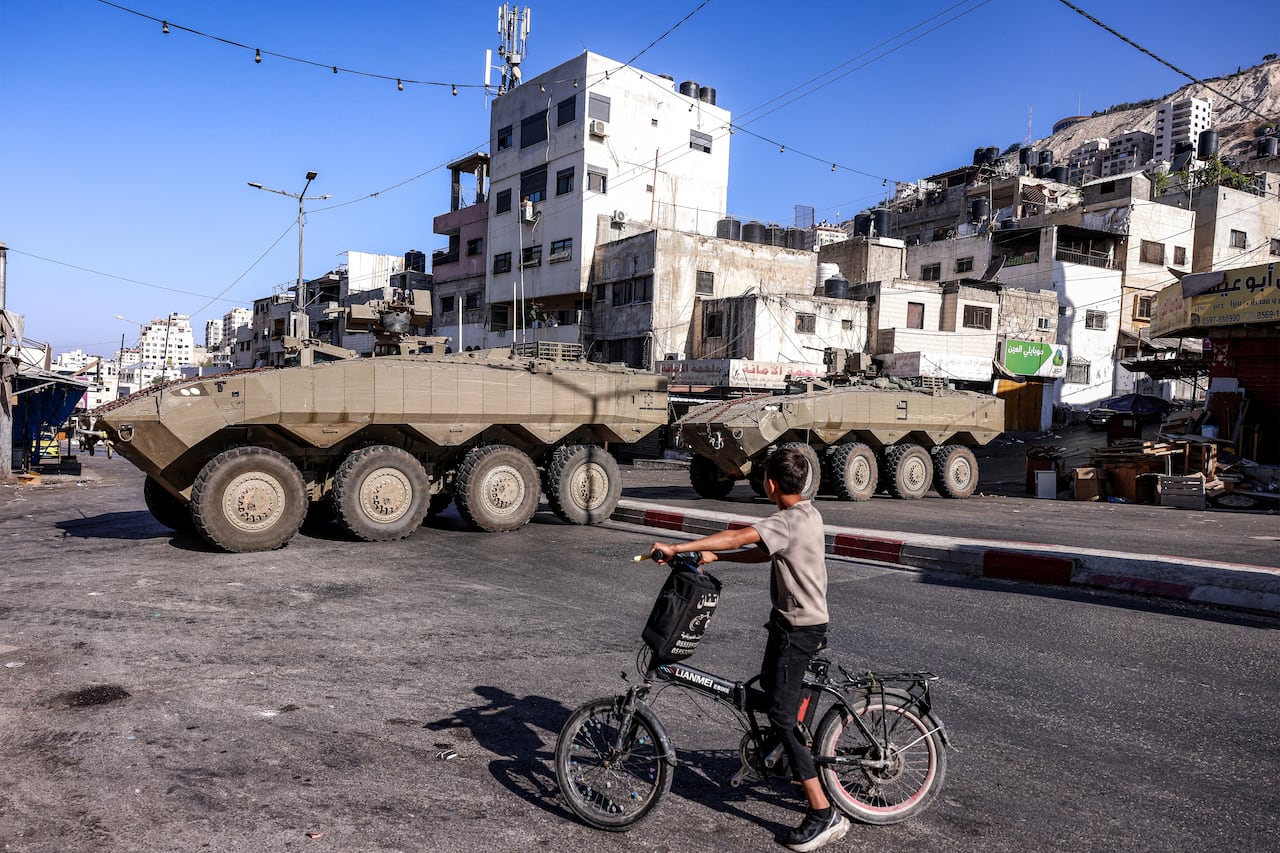
A boy stands with a bicycle near Israeli armored personnel carriers deployed during a military operation at the entrance of the Ain camp for Palestinian refugees, west of Nablus in the Israeli-occupied West Bank, on Thursday. (Zain Jaafar/AFP/Getty Images)
B’Tselem indicated that these policies are being carried out “more openly, directly, and violently” than in the past.
Israeli officials have typically claimed that violent settlers represent a small extremist minority acting outside of government policy, rather than being indicative of the wider settler movement or the state. However, the report contends that settler militias are not a “rogue external force” but an “operational arm of the territorial control mechanism.”
“Official state entities do not have to forcibly expel every community themselves. They create conditions in which armed settlers, with state support, render Palestinian life untenable,” it stated.
United Nations data indicates that settler violence in the West Bank has reached unprecedented levels.
-
Israeli settler blockades part of escalating violence against Palestinians in the occupied West Bank
-
Prosecutors charge Israeli settler for killing Palestinian activist in West Bank
In the first half of 2026 alone, over 1,260 incidents causing injuries or property damage were recorded, averaging about six incidents per day, while 18 Palestinians lost their lives in settler-related violence by late July, according to the UN Office for the Coordination of Humanitarian Affairs.
“The current situation in the West Bank is not merely a temporary crisis nor a series of random human rights violations,” the B’Tselem report asserts.
“It marks a rapid and distinct phase in an ongoing elimination project that operates within the framework of the Israeli apartheid regime, driven by a settler-colonial logic of dispossession, displacement, and the establishment of Jewish-Israeli sovereignty.”
The Israeli government did not provide a response to inquiries regarding the report.
Officials have dismissed claims from B’Tselem and other human rights organizations that characterize Israeli governance as apartheid or as a systematic effort to dispossess Palestinians, arguing that Israeli policies are motivated by security concerns and historical claims to the land.