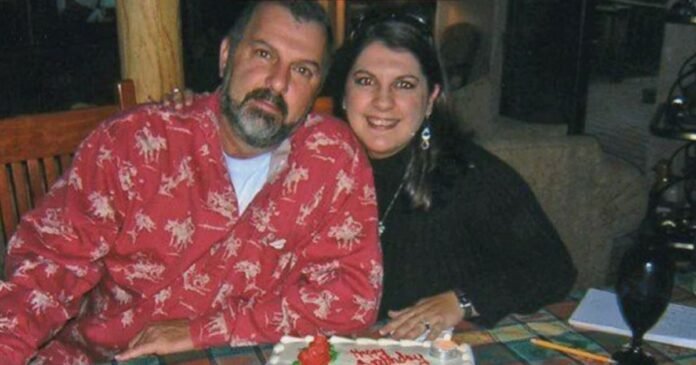

A woman has shared the shocking experience of receiving a call from law enforcement informing her that they had discovered her father’s head in a warehouse among more than 100 other bodies, despite her belief that he had donated his body to science.
Farrah Fasold’s father, Harrold Dillard, passed away from cancer at 56 in 2009. Prior to his death, while in hospice care, he was approached by a company named BioCare about donating his remains for medical practice purposes, specifically for knee replacement surgery training.
Describing her father’s positive reaction to the donation request, Farrah mentioned that he saw it as a way to ease the burden on his family and viewed it as a final selfless act. The family was assured that any unused body parts would be cremated, and his ashes would be returned at no cost.
Following his passing on Christmas Eve in 2009, his body was promptly collected from the hospice. Several months later, Farrah was distraught to learn that the police had discovered her father’s head.
Expressing her shock and distress, she emphasized that had they known about the possibility of body parts being sold, they would never have agreed to the donation, as it was not in line with her father’s wishes.
Authorities investigating the matter revealed that the bodies had been dismembered with a coarse cutting tool like a chainsaw, suggesting that a company involved in body acquisition had likely taken her father’s remains and sold parts instead of cremating the unused portions.
Farrah expressed her belief that her father’s body had been mishandled and not treated as promised by the company. She described vivid nightmares of body parts in containers and the impact it had on her mental well-being, leading to insomnia.
The practice of “body brokering” involves companies that act as intermediaries, obtaining remains from individuals under the guise of medical research donations and then selling them off, contrary to the donors’ expectations.
Unfortunately, many Americans donate their bodies each year believing they are contributing to scientific advancements, only to unknowingly be part of a commercial trade where their bodies are commodified in an unregulated market.
Distinct from the regulated organ and tissue transplant industry, these body brokers operate largely unchecked due to the lack of federal laws governing the sale of cadavers or body parts for research or educational purposes.
With minimal oversight in state regulations, almost anyone, regardless of qualifications, can handle and sell human body parts, leading to ethical concerns similar to historical grave-robbing practices.
Experts warn that the current scenario resembles a free-for-all situation, with inadequate safeguards in place to protect the dignity of donors and prevent exploitation in the body donation industry.