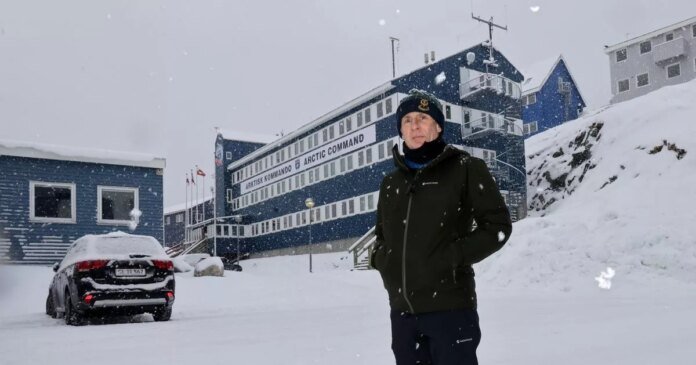

The Danish armed forces stationed at Joint Arctic Command in Greenland’s capital Nuuk are facing a heightened sense of urgency. Despite being housed in a modestly fortified blue building that may not deter potential threats, the situation has intensified following Donald Trump’s proposal to acquire Greenland in January 2025. As a response, a £3.5 billion expansion project has been initiated in the Arctic region, including the establishment of a new command headquarters in Nuuk to monitor potential threats.
In an unexpected turn of events, Denmark has also agreed to purchase 16 additional F-35 fighter jets from the US, bolstering its total fleet to 43 aircraft. Despite these defensive measures, President Trump has belittled the investment, suggesting it would only contribute the equivalent of a “single dog sled.”
Months before Trump’s controversial remarks, Denmark’s Defence Minister Troels Lund Poulsen emphasized the significant enhancement of the Danish Armed Forces’ capabilities in the region through the collaboration with Greenland and the Faroe Islands. The strategic positioning of the Arctic as a pivotal junction between North America, Russia, and Europe underscores the critical importance of these defense initiatives.
The defense package includes the acquisition of two new Arctic ships, maritime patrol planes, drones, and early warning radar systems to fortify the region’s security infrastructure. Danish personnel stationed in Nuuk are keenly aware of their obligation to engage any potential invaders promptly, as mandated by a 1952 directive that dictates immediate action without awaiting orders in the event of a territorial breach.
Prime Minister Mette Frederiksen has unequivocally stated that any military attempt to seize Greenland, an autonomous territory within the Kingdom of Denmark, would signify the dissolution of NATO. Amid escalating tensions, Trump’s claims of Russian and Chinese naval presence in Greenland have been refuted by Danish and Norwegian defense authorities, who have expressed concerns over heightened Russian naval activities in the Arctic Ocean without verifiable evidence of Chinese warships in the vicinity.