
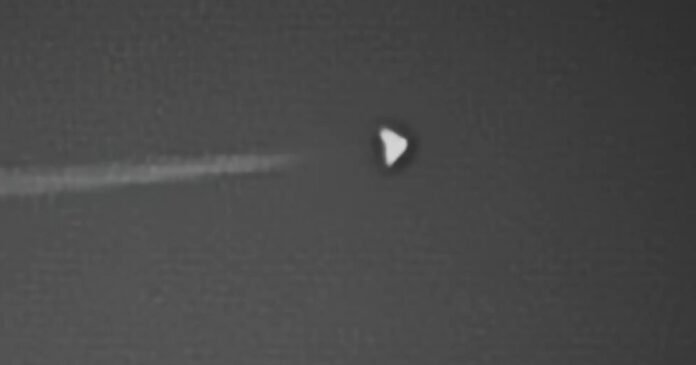

An adventurer captured a chilling photograph of a strange unidentified flying object hovering above the secretive military installation known as Area 51.
In the Nevada desert on January 14, a traveler documenting his journey near the base spotted an unusual sight in the night sky. Anders Otteson witnessed an unidentified craft resembling an “equilateral triangle,” commonly referred to by UFO enthusiasts as the ‘Dorito’.
Otteson observed a B-2 Spirit aircraft flying by two hours earlier, but the shape of the ‘Dorito’ UFO was distinct from the previous sighting.
Operating the YouTube channel “Uncanny Expeditions,” Otteson described the object he saw as lacking wings or flat tailing edges, prompting speculation about its nature.
Questioning whether it was a classified test flight or routine training activity, Otteson found the sighting intriguing.
Following this discovery, Otteson claimed that a radio scanner monitoring frequencies around Area 51 intercepted peculiar coded transmissions related to snacks and food items, such as “imperial with garlic” and “pretzel snack”.
Despite the strange encounter, Otteson suggested that the ‘Dorito’ object might have been a bomber plane, and the coded phrases could have been military terminology.
Otteson mentioned witnessing the ‘Dorito’ UFO shape on two previous occasions in different locations, suggesting a recurring pattern of sightings.
Area 51 has remained a enigmatic military facility shrouded in secrecy, fueling numerous conspiracy theories over the years about its activities and alleged extraterrestrial connections.
Although believers have long speculated about hidden alien technology at the base, the US government has consistently maintained that Area 51 serves as a testing ground for aircraft and related technologies.
Recent reports of a mysterious tower spotted via Google Earth at the site reignited speculations about alien technology, with social media users expressing concerns over the discovery.
A triangular tower casting a long shadow was unexpectedly sighted on Google Maps, attracting attention from online viewers curious about the structure’s significance.