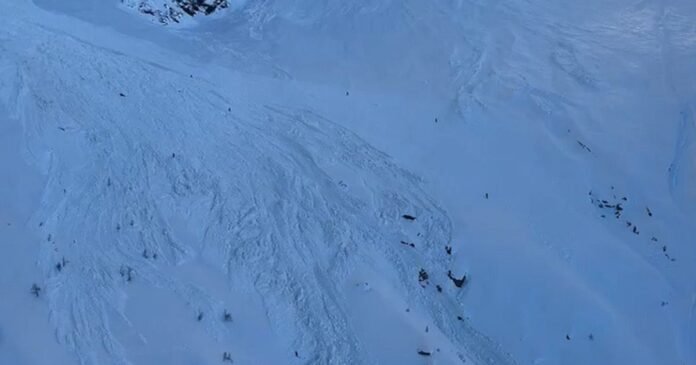

Two individuals have lost their lives while three others sustained severe injuries in an avalanche incident, as per reports. The avalanche hit Val Ridanna, a high-altitude valley in South Tyrol, Italy, just before 11:40 am local time on Saturday. Ten individuals, all reportedly equipped with Arva avalanche transceivers, were swept away when the snow mass broke away in the Racines area on Cima d’Incendio at 2,445 meters, according to Italian news agency LaPresse. Out of the ten affected, eight survived, with seven sustaining injuries – three severe and two minor.
The rescue effort involved five helicopters, with the Innsbruck operations center being notified. Requests for intensive care beds were made at hospitals in Merano, Bolzano, and Bressanone. The Guardia di Finanza and local Alpine rescue teams were present at the scene to assist.
In a recent report by the Austrian Alpine Club, it was revealed that almost all of Austria’s 96 glaciers have experienced retreat over the past two years, indicating the significant impact of climate change. Notably, the Alpeiner Ferner in the western Tyrol region and Stubacher Sonnblickkees in Salzburg have faced the most substantial losses, each retreating over 330 feet. On average, glaciers have retreated more than 65 feet.
The club emphasized the visible effects of climate change, particularly the ongoing disintegration of glacier tongues like at the Pasterze, Austria’s largest glacier. The report covering 2024 and 2025 reiterated the consistent trend of glacier shrinkage in Austria concerning length, area, and volume.
The diminishing glaciers in Europe have wide-ranging implications on various aspects such as drinking water, power generation, agriculture, infrastructure, recreational activities, and the Alpine environment. Switzerland, with the highest number of glaciers in Europe, has also observed a similar retreat in its glaciers, mirroring a global trend.
The decline in glaciers has been attributed to unfavorable weather conditions, including low snowfall and warm temperatures, with an exceptionally hot June recorded last year, nearly 5 degrees Celsius above average, as highlighted by the club. Club vice president Nicole Slupetzky stressed the urgency of the situation, stating that it is no longer a matter of preserving glaciers in their current state but rather mitigating the consequences for the future.