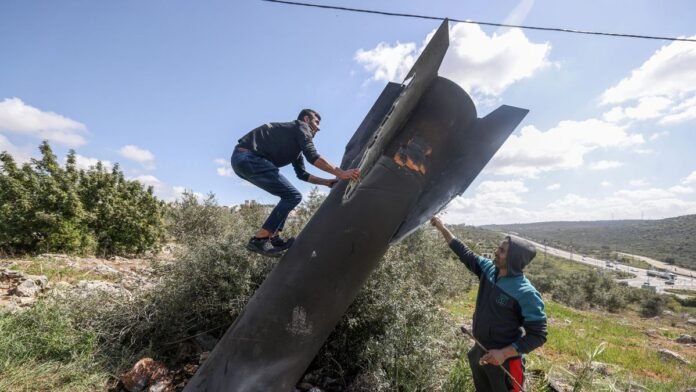

British military forces have successfully intercepted a significant number of “kamikaze” drones in a single night amidst the ongoing conflict with Iran, as per defense officials. Utilizing the Rapid Sentry defense system, specialized British troops managed to shoot down at least 14 incoming missiles believed to be launched by Iran or its allies. These troops, part of the RAF Regiment, were stationed in Erbil, Northern Iraq, alongside US forces to safeguard shared assets.
With this latest achievement, the RAF Regiment units based in Northern Iraq have now neutralized approximately 70 drones and missiles since the conflict began. They deployed the Lightweight Multi-role Missile – LMM Martlett – with a range of around five miles, fired from Rapid Sentry launchers. A British official highlighted that there was a surge in hostile activities, particularly in Erbil, where the troops thwarted 14 one-way attack drones in a single night, marking the highest interception rate in a night since the conflict’s inception.
The conflict escalated when a small drone struck the UK base RAF Akrotiri in Cyprus, launched by one of Iran’s proxy forces stationed in Iraq or Lebanon. Subsequently, there were conflicting reports regarding potential peace talks between the US and Iran, with Iran accusing President Donald Trump of spreading misinformation. Despite denials of talks by Iran, reports emerged suggesting a willingness for negotiation from Iran’s new Supreme Leader, Mojtaba Khamenei, who allegedly sustained severe injuries in an airstrike that claimed the lives of his father, Ayatollah Khaemeni, along with his mother and son.
Intensive airstrikes by US and Israeli forces targeted military installations and key figures in Iran, triggering substantial damage across the country, as reported by the Iranian Red Crescent Society. The humanitarian organization stated that over 82,000 civilian structures had been impacted by the airstrikes, including 281 medical facilities such as hospitals, clinics, and pharmacies. Amidst these developments, there were claims that Saudi Arabia’s de facto leader, Prince Mohammed bin Salman, was advocating for the continuation of the conflict against Iran, citing an opportunity to reshape the geopolitical landscape of the Middle East by dismantling Iran’s ruling government.
Prince Mohammed emphasized Iran’s perceived long-term threat to the Gulf region and the necessity to eliminate the current government. Tensions between Saudi Arabia and Iran have been longstanding, particularly evident in their proxy war in Yemen and strained diplomatic relations. Additionally, Israel conducted strikes in Lebanon targeting fuel stations utilized by Hezbollah, rendering them inoperable and further escalating hostilities in the region.
The intensifying conflict saw multiple missile attacks and drone interceptions in various countries, with reports of casualties and widespread destruction. Explosions resonated across Iran, with reports of mines laid in the Strait of Hormuz posing additional maritime threats. The region’s death toll surged, with casualties reported in Iran, Lebanon, Israel, the US, and Gulf states, underscoring the escalating humanitarian crisis and security concerns in the conflict-ridden region.