
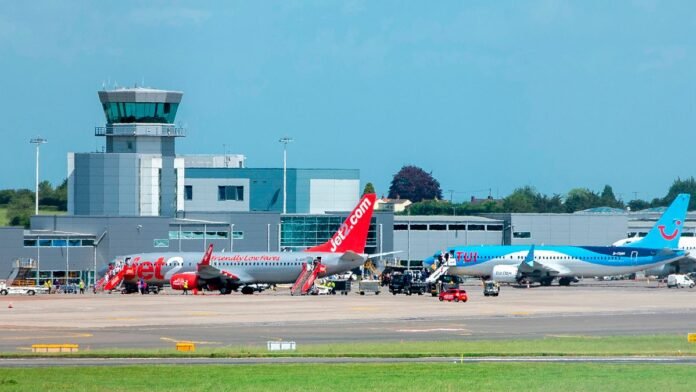

An advertisement labeled as ‘obscene’ showcasing an AI worker who ‘never requests a pay raise’ has received criticism and was later removed from display at an airport. The ad, displayed on a digital billboard at Bristol Airport, features a woman with a half-human, half-robotic face alongside text stating: “Meet your new AI employee. She outperforms everyone and will never seek a pay increase.”
The concept was created by Narwhal Labs, an AI company based in Bristol, but faced backlash online for seemingly endorsing stagnant wages and downplaying the impact of automation on employment. Critics have condemned the message as “obscene” and “truly awful,” alleging that it portrays the woman in a subservient role.
Following concerns raised about the content, the advertisement was removed from Bristol Airport by the advertising company responsible. Additional ads by Narwhal on LinkedIn feature the same AI character, promoting her as “always available, never absent, and no HR needed.” The campaign suggests that while employees work 9-5, she operates 24/7 and starts working for free.
Critics on LinkedIn expressed disapproval, with one user stating that the ad provides a reason to avoid engaging with the company or its marketing efforts. Another commenter highlighted the implicit assumption that the AI worker could easily replace human interactions and connections without considering the long-term impact on relationships and trust.
Moreover, some criticized the gendering of the AI as a woman, arguing that AI should be considered gender-neutral. The advertisement, part of Narwhal Labs’ ongoing ‘Autonomous AI Communications’ campaign, aims to deploy autonomous agents across various communication channels to assist companies.
In contrast, a male AI employee in a separate ad is portrayed as efficient, emphasizing his ability to find, contact, and follow up on tasks while others rest. Critics pointed out that framing the AI as a tireless female worker perpetuates unfair expectations on women to overperform without adequate recognition or compensation.
Responding to the backlash, Narwhal Labs CEO Luke Sartain acknowledged the concerns raised by the campaign and clarified that the intention was not to convey misogynistic or racist messages. He emphasized that the billboards featured diverse demographics to highlight the broader issue of humans versus machines, stressing the need for a debate on the future of work in the face of advancing technology.
Sartain added that the goal was to prompt discussions on the evolving role of humans in a world where efficiency is no longer solely human-driven, aiming to democratize AI technology for small and medium-sized businesses. The company’s focus is on addressing the challenges posed by automation rather than displacing specific groups, advocating for proactive responses to the changing landscape of work.