
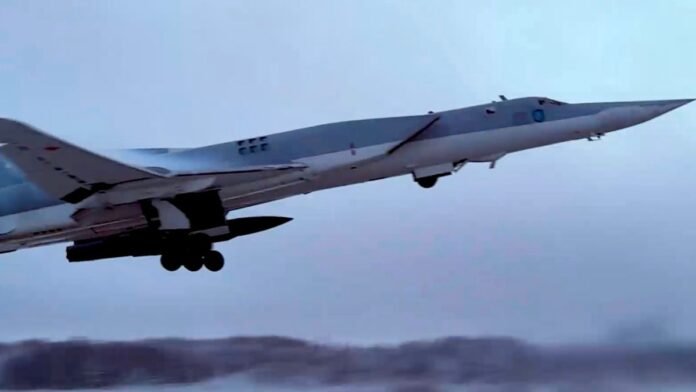

NATO fighter jets were deployed to monitor Russian strategic bombers that were on a mission over the Baltic Sea amid escalating tensions in the area. The Russian air force, led by Vladimir Putin, conducted the operation in international airspace with Tu-22M3 bombers escorted by Russian Su-35 fighter jets. The Russian defense ministry’s TV channel, Zvezda, confirmed that NATO fighters had been monitoring the bombers at various points during the mission, emphasizing adherence to international airspace regulations. Notably, Russian footage of the mission showed a visible F-35 aircraft, which is utilized by multiple NATO air forces.
This display of military strength by the Kremlin coincided with allegations from Moscow accusing Finland, Estonia, Latvia, and Lithuania of allowing Ukrainian drones to pass through their airspace to target key Russian oil facilities. These claims have been strongly denied by Western nations and Kyiv. Despite the denials, senior Russian officials, including Foreign Minister Sergei Lavrov, have issued stern warnings to the West regarding potential retaliatory actions.
Russian Security Council Secretary Sergei Shoigu invoked Russia’s right to self-defense, hinting at possible military responses against Finland, Estonia, Latvia, or Lithuania. Concerns have been raised that Russian President Putin might test NATO’s Article 5 collective defense commitment through a calculated incursion in the Baltic region, potentially targeting an island. Sweden’s Chief of Defence, Michael Claesson, has cautioned that Russia may be planning to seize an island belonging to a Western nation in the Baltic Sea, posing a direct challenge to NATO.
Islands such as Sweden’s Gotland, Denmark’s Bornholm, and Estonia’s Hiiumaa and Saaremaa are among those considered at risk. Shoigu highlighted the increasing incidents of Ukrainian drone attacks on Russia via Finland and the Baltic states, leading to civilian casualties and damage to infrastructure. He suggested that either western air defenses were ineffective or the states in question were complicit in aggression against Russia by allowing their airspace to be used for such attacks.
Shoigu emphasized the application of Article 51 of the UN Charter, asserting the right of states to self-defense in the face of armed assaults. Referring to Ukrainian strikes that impacted Russian oil ports, another close ally of Putin, Nikolai Patrushev, accused NATO members of complicity in these acts. Lawmaker Andrei Kolesnik, known for his hardline stance, interpreted Shoigu’s statements as a final warning, backed by Putin’s authority, cautioning Baltic states against acting with impunity towards Russia.