
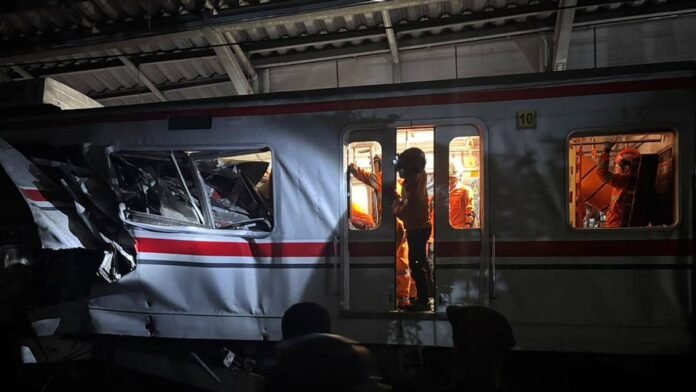

Two trains collided in Indonesia, resulting in the death of at least four individuals and the entrapment of numerous passengers. The incident occurred when one train struck another at a station near Jakarta, causing severe damage to a carriage and trapping occupants inside.
According to a statement from state-owned railway company PT Kereta Api Indonesia, four fatalities have been confirmed, and 38 passengers were transported to hospitals for medical attention. The collision involved the Argo Bromo Anggrek long-distance train crashing into the rear car of a commuter train at Bekasi Timur Station, where the affected carriage was designated exclusively for women.
Rescue efforts are underway to reach five passengers still trapped in the commuter train car, with concerns that the death toll might rise. The rescue operation is challenging due to the extensively damaged train carriages, necessitating rescuers to cut through twisted metal to access the trapped individuals. Additionally, authorities temporarily suspended overhead electric power along the Cibitung–East Bekasi line for safety during the evacuation.
Injured passengers have been taken to nearby medical facilities, including Bekasi Regional Hospital, where reports indicate an overwhelming influx of patients. Many of the injured passengers, predominantly women returning from work, have suffered fractures, as per initial assessments.
All 240 passengers aboard the Argo Bromo Anggrek train are reportedly safe. Police are investigating the cause of the accident, as stated by Jakarta Police Chief Asep Edi Suheri at the scene. Videos circulating on social media depict chaotic scenes at the station, with passengers panicking and concerned individuals rushing for updates on their loved ones.
Unfortunately, accidents are not uncommon on Indonesia’s aging railway network. In previous incidents, similar collisions have resulted in fatalities, such as a collision in West Java in January 2024 and another in West Java in October 2013. These incidents underscore the ongoing safety challenges faced by the country’s rail infrastructure.