
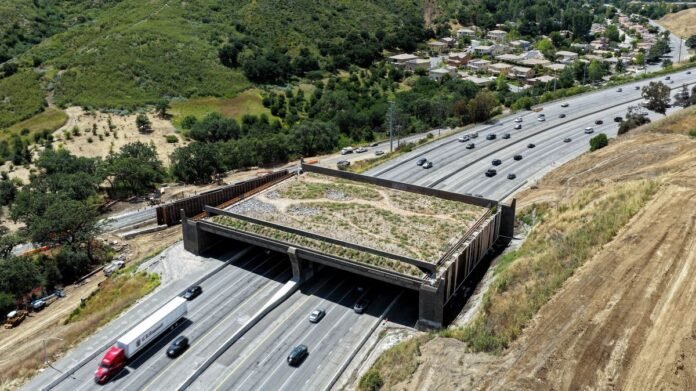

After facing numerous challenges and setbacks, the grand opening of the world’s largest wildlife bridge has been unveiled following cost overruns and construction delays that postponed the project by at least a year.
Construction on the Wallis Annenberg Wildlife Crossing over the 101 Freeway in Agoura Hills, located north of Los Angeles, has been ongoing for four and a half years. The official opening date is set for December 2, as confirmed recently.
Announced on Earth Day by project leaders, the completion of the main section of the bridge, spanning 10 freeway lanes, along with landscaping, marks a significant milestone. Remaining tasks include constructing over Agoura Road and linking both ends of the bridge to the surrounding open space.
The primary objective of the wildlife bridge is to facilitate safe passage for various wildlife species. Beth Pratt, the regional director for the National Wildlife Federation in California, has observed diverse wildlife, including butterflies and birds, utilizing the bridge even before its full integration with the landscape.
The project aims to revive the mountain lion population in the area and provide a safer route for animals, such as bears, bobcats, foxes, coyotes, and deer, that frequently fall victim to vehicle collisions on the freeway.
Despite encountering multiple delays and criticisms, the project initiated in 2022 with a $90 million budget (£66.5 million) and was initially projected to complete by 2025. However, recent reports indicate that the total cost has escalated to $114 million (£84.5 million), funded through a combination of private donations and public contributions.
Project leaders attribute the rise in costs to adverse weather conditions, particularly near-record rainfall in 2023 and 2024, labor shortages, inflation, and the intricate nature of the construction.
In response to criticisms, project leaders emphasized the complexity of the endeavor, stating that they are essentially constructing a thriving ecosystem above a busy freeway. They underscored the importance of evaluating such large-scale projects while emphasizing the significance of addressing environmental concerns in Southern California.