
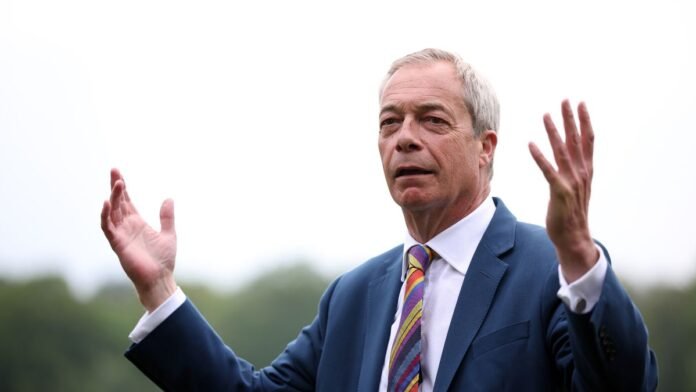

Nigel Farage’s boasting and Reform UK’s celebration cannot mask a fundamental flaw in their recent success. Despite significant gains in various local elections, including in England, Wales, and Scotland, Farage may have reasons to be less confident privately than he appears publicly.
Although Reform performed impressively, outperforming several other parties in England, notably Labour, with a gain of 1,451 seats, there was a noticeable decline in their national vote share. Political analysts Colin Rawlings and Michael Thrasher reported a 5% drop to 27% compared to the previous year, raising concerns for Farage and offering hope to his opponents.
Farage’s party, funded by dubious sources and facing controversies like financial irregularities and unfulfilled commitments, is not riding a wave of widespread popularity but is rather led by a privileged few evading scrutiny. This lack of broad appeal limits Reform’s potential, as indicated by the party’s recent peak and the unlikelihood of a strong showing in a general election.
Experts analyzing voting patterns suggest a significant divide between left-leaning parties like Labour, Greens, and Lib Dems, and right-leaning parties such as Reform and Conservatives. This polarization could relegate Farage to irrelevance, with tactical voting potentially thwarting his ambitions for power.
The evolving political landscape, with multiple parties vying for support under a winner-takes-all system, poses challenges for all players, including Reform. Despite their current position as the leading minority party, they fall short of Labour’s past electoral success, hinting at a probable hung parliament or a fragile government in the future.
Farage’s aspirations for power, despite his financial backing, are uncertain, especially given the shifting political dynamics and the need for coalition-building. The upcoming period will test his leadership and the sustainability of Reform’s influence.
As the political scene continues to evolve, strategic moves like emphasizing national interests, as exemplified by Keir Starmer’s proposals, could shape public perception and differentiate parties like Labour in the eyes of voters. The future remains uncertain, with potential challenges and opportunities ahead for all political actors.