
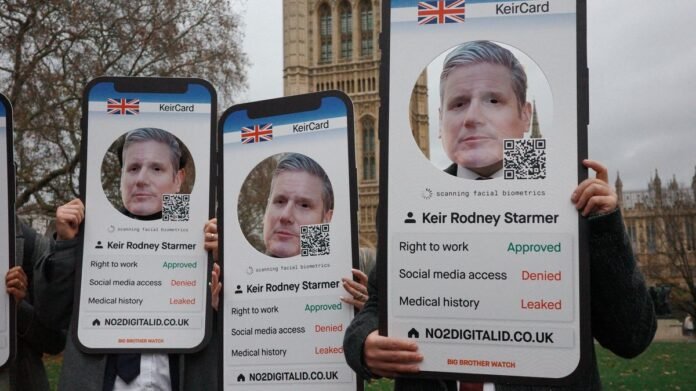

Keir Starmer’s push for digital identification has been deemed a failure, potentially hindering future attempts to gain public support for its benefits, according to a critical report. The Home Affairs Committee, comprising members from various political parties, criticized the Government for hastily advancing the plans without adequate policy groundwork or public buy-in. The Government had to abandon the proposal for mandatory ID cards due to significant opposition.
Lawmakers acknowledged the potential advantages of introducing digital ID but highlighted the detrimental impact of the poorly managed policy on public trust. Dame Karen Bradley, the committee chair, described the initial government communication as chaotic and lacking coherence, leading to concerns about government intrusion and a lack of clarity in addressing those worries.
Initially well-received by the public, the policy direction took an unexpected turn, causing skepticism and confusion among citizens. The government has since revisited its approach, aiming to rebuild trust in the concept of digital ID, which could serve as a valuable government tool.
In September last year, Keir Starmer announced plans to mandate digital ID for proving the right to work in the UK by 2029, sparking significant opposition, including a petition with three million signatures demanding a reconsideration of the decision. The Government has now clarified that while digital right-to-work verifications will be compulsory, there will be no obligation to use digital ID. Furthermore, a public consultation has been initiated to explore the implementation of online identification checks.
Last year, the think-tank Labour Together, closely associated with Keir Starmer, proposed the BritCard initiative, designed to enable all UK residents to demonstrate their right to live and work in the country. In a statement in September, the Prime Minister emphasized the potential of digital ID to enhance border security by reducing illegal work opportunities in the UK.
However, the committee’s report criticized the Government for failing to present a convincing argument for the policy. It highlighted the lack of thorough policy development and public engagement prior to the announcement, which triggered apprehension and uncertainty among the general populace. The mishandling of the policy also jeopardized the digital verification services sector, a significant contributor to the UK economy.
Alexander Iosad from the Tony Blair Institute contended that more individuals support digital ID than oppose it, suggesting that while the government’s communication efforts could have been better, the debate surrounding digital ID remains crucial. Former Prime Minister Tony Blair has long advocated for ID cards, but previous attempts by the Labour Government to implement a similar scheme were unsuccessful.