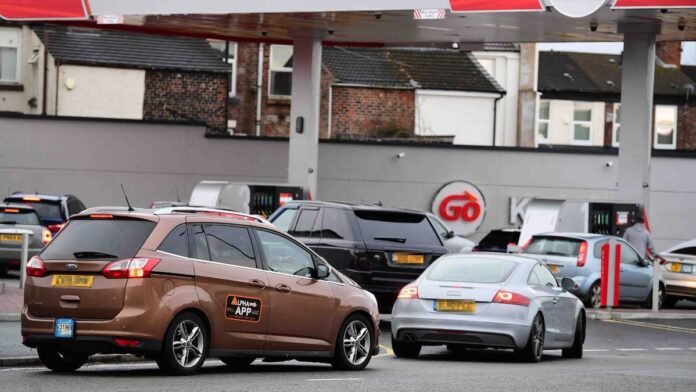

Britons have received advice to opt for remote work and reduce driving speed amid the escalating energy crisis linked to the Middle East conflict, which is now causing a severe economic downturn.
Global oil prices have surged as a consequence of the US-Iran tensions focusing on the Strait of Hormuz, a critical route for oil shipping worldwide.
Households can expect a substantial increase in energy costs, with the bill for the average dual fuel consumer projected to rise to £1,973 annually by July, coinciding with the next energy cap review. Furthermore, petrol prices have soared to 142.62p per liter, with unleaded petrol reaching 162.66p per liter, prompting the International Energy Agency (IEA) to urge immediate measures to curb demand.
To address these challenges, the IEA recommends the following actions:
1. Opt for remote work whenever feasible to reduce oil consumption related to commuting.
2. Implement a minimum 10 km/h reduction in highway speed limits to lower fuel usage for vehicles.
3. Promote the use of public transportation over private cars to swiftly decrease oil demand.
4. Introduce number-plate rotation schemes in major cities to alleviate congestion and fuel-intensive driving.
5. Encourage car-sharing and adopt eco-friendly driving practices to enhance fuel efficiency.
6. Implement efficient driving practices, maintenance, and load optimization for commercial vehicles to reduce diesel consumption.
7. Shift LPG use away from transportation to preserve it for essential needs like cooking.
8. Minimize air travel in favor of alternative options to alleviate pressure on jet fuel markets.
9. Transition to modern cooking solutions like electric cooking to reduce reliance on LPG.
10. Enhance operational efficiency in industries utilizing petrochemical feedstocks to reduce oil consumption and free up LPG for essential purposes.
By implementing these measures, individuals and industries can contribute to mitigating the energy crisis and reducing the strain on global oil supplies.