
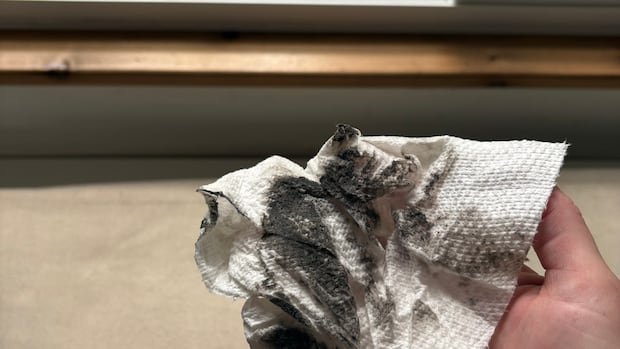

A group of scientists in Hamilton has uncovered insights into the particulate matter settling on neighborhoods near the city’s industrial zone. Residents have long been troubled by a dark, sooty residue coating their properties, with a recent surge in complaints about heightened fallout in early July.
Sarah Styler, an environmental chemistry associate professor at McMaster University, along with Grace Yao, a PhD student in Styler’s lab, are part of a research project titled “What’s the Grime?” aimed at addressing this issue. Through collaboration with volunteers who gathered samples across the city in 2024 and 2025, the team discovered that the soot contains hazardous substances associated with coal burning. Additionally, elevated levels of dust and polycyclic aromatic hydrocarbons (PAHs) were detected closer to the industrial hub in northeast Hamilton.
Styler, in partnership with Environment Hamilton, conducted the study with a $15,000 grant from the university in 2024. Both Styler and Yao, residing in east Hamilton and Corktown respectively, have personal encounters with the soot issue. The research revealed historical references to the soot dating back to the 1950s, emphasizing its long-standing presence in the community.
The investigation involved the collection of soot samples from 50 households in the city using sampling kits. Scientists analyzed these samples at four-month intervals to track the composition of the soot. Styler highlighted that proximity to the industrial zone correlated with increased dust deposition and the presence of toxic compounds.
The team’s findings indicated higher PAH levels during winter compared to summer, suggesting seasonal variations in pollution. While the study focused on 13 PAHs, Styler noted the possibility of other harmful substances in the grime, describing it as a viscous mixture. Though resource constraints limited the scope of the analysis, coal combustion was identified as a significant source of the PAHs observed.
Styler emphasized the need for continuous monitoring and enhanced analytical capabilities to pinpoint specific industrial sources generating the PAHs. The community, particularly those directly impacted by the fallout, may not be surprised by these findings, attributing the soot to industrial emissions. Despite public frustration over the lack of official information, efforts are underway to determine the exact sources of the pollution.
The researchers plan to present their results at a community meeting on August 20 and are preparing a manuscript for peer review. They aim to expand the study to 200 participants, explore additional compounds in the grime, and investigate effective cleaning methods for the affected areas.