
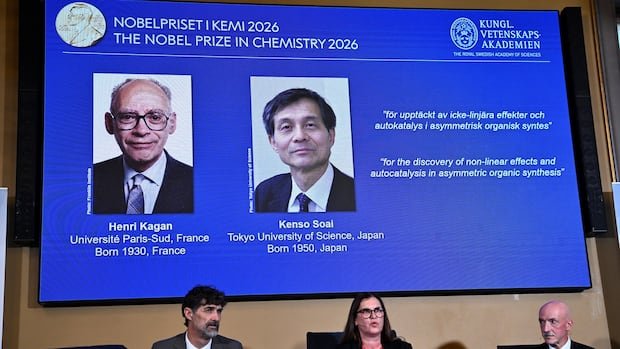

Henri B. Kagan and Kenso Soai were awarded the Nobel Prize in Chemistry for their groundbreaking research on non-linear effects and autocatalysis in asymmetric organic synthesis. This discovery addresses a long-standing chemical mystery of how homochirality can spontaneously emerge, as stated by Heiner Linke, chair of the Nobel Committee for Chemistry. Their developed chemical reactions have proven to be crucial for pharmaceutical manufacturing processes.
Kagan, a 95-year-old French national affiliated with Université Paris-Saclay in Orsay, France, and Soai, born in Japan in 1950 and currently conducting research at the Tokyo University of Science, have made significant contributions to the field of chemistry. The Royal Swedish Academy of Sciences in Stockholm announced the laureates, who will split a prize of 12 million Swedish crowns ($1.7 million Cdn).
The Nobel laureates’ work has enabled chemists to manipulate reactions to selectively produce mirror-image molecules, a vital aspect in pharmaceutical synthesis. Soai expressed his excitement upon receiving the news, describing it as one of the most thrilling moments in his life. He shared that he was shopping near his residence when the Nobel committee contacted him.
The Nobel Prize in Literature will be revealed on Thursday, followed by the peace prize on Friday, and the economics prize on October 12. The Nobel prizes ceremony is scheduled for December 10, in accordance with Alfred Nobel’s will, where individuals who have made significant contributions to humanity are recognized and awarded.