
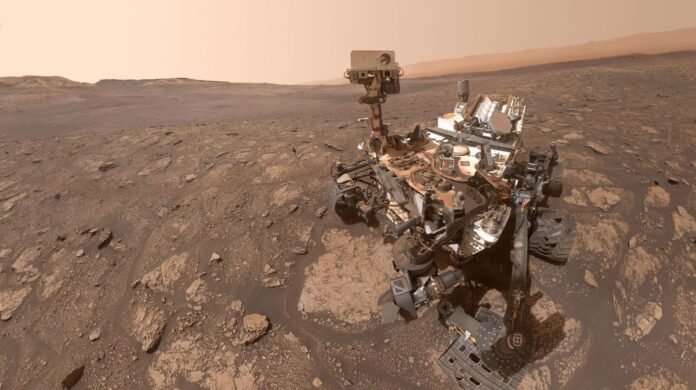

NASA’s Mars Curiosity rover has made a significant discovery of previously unseen organic compounds, potentially providing compelling evidence of past life on the Martian surface. The findings, obtained through a unique chemical experiment conducted on Mars, indicate the presence of diverse organic molecules, some of which are fundamental building blocks for life as we know it. Scientists believe that these findings demonstrate the capability of the Martian environment to preserve ancient molecular signatures that could point to the existence of past life forms.
Despite the rover’s success in uncovering these critical samples, further exploration efforts have been hindered by a funding shortfall within the US space agency, exacerbated by proposed budget cuts under the Trump administration. A planned initiative, the Mars Sample Return program aimed at retrieving rock samples for detailed analysis on Earth, was terminated earlier this year due to budget constraints.
The decision to halt the Mars Sample Return program has raised concerns among planetary scientists and NASA officials, with some expressing disappointment over the potential setback to American leadership in space exploration. The reduction in funding, part of a broader attempt to decrease NASA’s budget, poses challenges to ongoing missions and future endeavors within the space agency.
While the recent experiment conducted by Curiosity cannot definitively distinguish between organic compounds of biological origin and those formed through geological processes or external sources like meteorites, it marks a groundbreaking achievement in the search for extraterrestrial life. The identification of various chemicals, including a nitrogen-bearing molecule resembling DNA precursors and benzothiophene, provides valuable insights into the potential for life to exist beyond Earth.
Led by NASA’s Jet Propulsion Laboratory, the Curiosity rover carried out the experiment in the Glen Torridon region of Gale crater, a site rich in clay minerals indicative of past water presence. These clay minerals are known to effectively preserve organic chemicals, making them a prime target for scientific investigations.
The experiment, conducted using the Sample Analysis at Mars (SAM) instrument suite, utilized a chemical called TMAH to break down organic molecules for analysis. Despite the limited availability of the TMAH chemical onboard Curiosity, meticulous planning and strategic sampling locations led to the successful identification of organic compounds.
The promising results of the study, published in the journal Nature Communications, highlight the importance of continued exploration efforts in the search for organic compounds on Mars. Future missions, such as the Rosalind Franklin mission to Mars and the Dragonfly expedition to Saturn’s moon Titan, are expected to incorporate similar chemical analyses to further explore the potential for life beyond Earth.
In conclusion, the recent findings from the Curiosity rover underscore the significance of preserving and analyzing complex organic compounds on Mars, offering valuable insights into the planet’s habitability and potential for past life forms.