
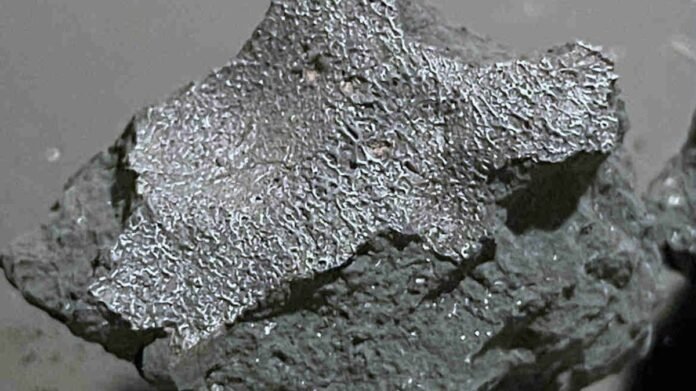

A meteorite that impacted a residence has been discovered to contain extraterrestrial “salty” fluids that might harbor the fundamental elements necessary for life. Researchers suggest that the unique chemistry within the space rock could potentially generate essential life-building molecules on Earth. The meteor caused a sonic boom in New York City as it flew past the Statue of Liberty on July 16, 2024.
Shortly after, the 2lb meteorite crashed through the roof of a house in Hillsborough, New Jersey. Dr. Peter Jenniskens, the lead author from the SETI Institute, explained that a detailed examination of the fragments unveiled preserved materials from the surface of a primitive asteroid where it encountered concentrated salty fluids, a phenomenon not previously observed in this type of celestial body.
The meteor, comparable in size to a heavy airline bag, entered the Earth’s atmosphere at a velocity of 32,000 miles per hour. Mike Hankey, the operations manager at the American Meteor Society, highlighted that various cameras captured the meteor’s trajectory from different locations, leading back to the lower region of the asteroid belt. The fragile rock disintegrated into pieces upon entry into the atmosphere.
The meteor became invisible at an altitude of 22 miles. Subsequently, a Doppler weather radar at Newark Airport briefly detected a cloud of falling pebbles stretching from Staten Island to New Jersey. Hillsborough was situated at the end of this cloud, where the larger rocks descended, with only one being recovered due to its impact on a house. The homeowner reported a loud crash, a hole in the bedroom ceiling, a sulfur-like smell, and the presence of black fragments and debris.
Following the incident, the homeowner promptly preserved and documented the scene by collecting meteorite fragments in glass jars. Further analysis by scientists identified the rocks as belonging to a specific type of primitive meteorite known as CM-type carbonaceous chondrites. These meteorites are of significant interest due to their potential to contain salts and briny fluids that could foster the creation of essential molecules for life on Earth.
Experts are now focused on identifying the salt minerals within the meteorite for comparison with samples from other asteroids. The high concentration of salt in briny fluids may play a vital role in catalyzing chemical reactions necessary for life. The discovery of organic compounds within the meteorite suggests a potential contribution to Earth’s prebiotic organic inventory, offering insights into the origin of life on our planet.
A selection of meteorite fragments will be showcased at the American Museum of Natural History in New York City, where Curator Denton Ebel expressed excitement over the valuable asteroid sample collected from the recent event.