
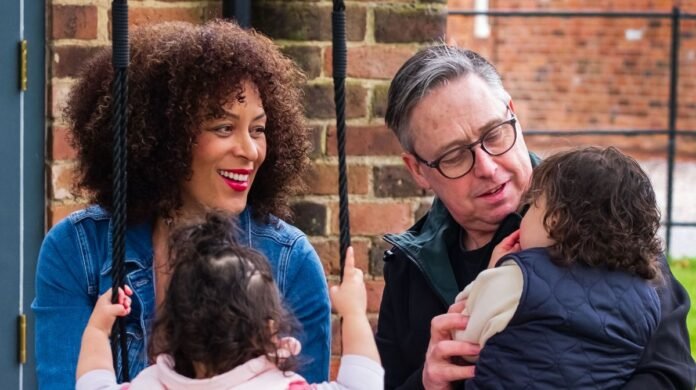

Recent studies indicate that older women face reduced success rates with fertility treatments, even when using donor eggs. Despite this, a mother who gave birth to twins at 51 emphasizes the need for systemic changes.
Caroline Morgan, now 53, previously shared her journey of achieving motherhood through six rounds of IVF, diverging from her peers who were transitioning into empty nesters.
In a recent editorial for the Mirror, Caroline, residing in South Derbyshire, reflects on research indicating that women over 49 face a higher risk of miscarriage and reduced pregnancy chances, even with donor eggs, which were once deemed a potential solution.
Findings unveiled at the European Society of Human Reproduction and Embryology (ESHRE) point to age-related changes in the womb lining as a probable cause. This discovery holds promise for future treatments, potentially enabling doctors to forecast, prevent, or enhance uterine aging.
Reflecting on her personal journey, Caroline states, “Women need access to information to make informed decisions rather than instilling fear. The latest research on age’s impact on fertility treatment success reminded me of my own path. At 51, after undergoing IVF, I became a mother to twins. While grateful for my journey to motherhood, it shed light on the gaps in our knowledge of fertility, reproductive health, and women’s choices.
“Embarking on fertility treatments revealed underlying issues like fibroids and womb lining problems. It made me ponder whether these issues existed undetected for years, possibly since my early thirties,” Caroline reflects.
She points out the importance of discussing fertility health proactively, suggesting that fertility awareness should be integrated into women’s healthcare from an early age, similar to other health screenings.
Through her podcast, Motherhood in Stereo, Caroline has encountered women whose fertility journeys were unexpectedly influenced by various factors, emphasizing the significance of early knowledge about one’s body for informed decision-making.
Her message advocates for empowering women through open conversations about reproductive health, aiming to normalize discussions around fertility and provide support throughout their life stages.
Caroline concludes by encouraging women to seek information, engage with healthcare professionals, and feel supported throughout their fertility journeys, emphasizing the importance of knowledge, support, and compassion in the process.
Julia Banim is a Mirror reporter focused on gripping human interest stories and all things celeb and TV-related. She is passionate about a range of social issues, from healthcare to housing, and also enjoys writing more lighthearted pieces about new lifestyle trends, food, and relationships. She’s always interested in hearing about any fascinating case studies, interview opportunities, or timely campaigns. Before joining the Mirror in January 2022, Julia worked as a journalist for UNILAD.
Choose Daily Mirror as a ‘Preferred Source’ on Google News for quick access to the news