
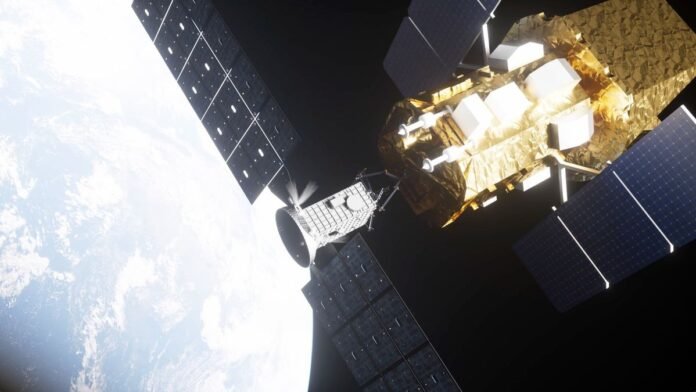

NASA has launched a daring mission to retrieve the Swift observatory as it approaches re-entry into Earth’s atmosphere. The unique Swift observatory, capable of detecting powerful cosmic explosions from the early universe, is at risk of burning up unless rescued. A spacecraft robot, similar in size to a fridge and equipped with small thrusters, has been deployed to grab and return the car-sized observatory to its safe orbit at 373 miles.
The successful retrieval of Swift could pave the way for saving other critical satellites, including the renowned Hubble Space Telescope, potentially saving significant costs. NASA enlisted the private firm Katalyst Space Technologies to construct the spacecraft and carry out this high-risk, high-reward mission.
Recent increased solar activity has caused Swift’s descent, with its orbit now at around 220 miles and on track to potentially burn up in October. Despite weather and technical delays, the Link spacecraft was successfully launched from the Marshall Islands using a Pegasus rocket attached to a modified airplane. It is expected to rendezvous with Swift in approximately one month.
Experts, like Dr. Simeon Barber from the Open University, express hope in the mission’s success, emphasizing the importance of Swift in studying high-energy phenomena. Launched in 2004, Swift, with its three telescopes, was a £220 million investment to study cosmic events like gamma-ray bursts. The rescue mission for Swift alone has cost NASA £22 million.
The spacecraft will gradually raise Swift’s orbit to ensure long-term stability, allowing for continued scientific observations. The potential success of this mission opens the door for future satellite rescue missions, with the Hubble Space Telescope being a prime candidate for retrieval. The retrieval of non-serviceable satellites presents a cost-effective opportunity for extending and enhancing existing spacecraft functions.
Kieran Wilson, vice president of technology at Katalyst Space Technologies, anticipates the Swift Boost mission will revolutionize how astronomers view satellite lifespans. This advancement could significantly impact the future of space exploration and satellite sustainability.