
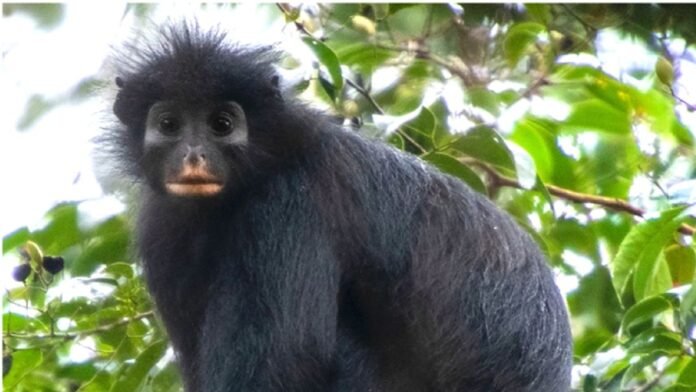

A distinctive new monkey species with vibrant orange lips has been officially identified in Africa, almost two decades after its initial sighting. This small primate, characterized by its black fur and long tail, belongs to the Colobus genus native to Africa. The discovery took place at the Lomami National Park, situated in the interfluve region of the Lomami and Congo (Lualaba) rivers in the east-central Democratic Republic of Congo (DRC).
Known as Colobus congoensis or Likweli, this primate marks only the fifth new African monkey species found in the last 75 years. Initially observed in 2008 during an exploration of the Lomami Basin, the Likweli monkeys were not seen again until November 2018. Subsequently, between 2018 and 2022, there were 114 sightings of these monkeys, yet local communities remain largely unaware of this newly discovered species, with only eight out of 52 surveyed localities reporting knowledge of the primate and its accurate description.
Described in a research publication in the PLoS One journal, the Likweli monkey’s distinguishing feature is the dark glabrous face adorned with a prominent pinkish to orange-cream bare skin patch around the mouth area, extending from the upper lip to the nasal alae. The size of this colored patch varies among individuals, giving some monkeys a more extensive coverage on their lower face, while others have a more limited area. The black skin surrounding the patch and covering the eyelids and eye area creates a “mask-like appearance” for the monkey.
This newly discovered species is classified as a “rare and cryptic monkey,” primarily found in high, dense canopy forests. The research team advocating for its endangered status attributes this classification to the restricted range and population size of the species, exacerbated by increased hunting pressure and habitat conversion. To safeguard the conservation of C. congoensis, the researchers emphasize the necessity of protecting the Lomami National Park, where most of the species’ range is located, and involving local communities in refraining from hunting these monkeys.
The study was conducted by a team of experts from the Democratic Republic of Congo, the United States, and Germany.