
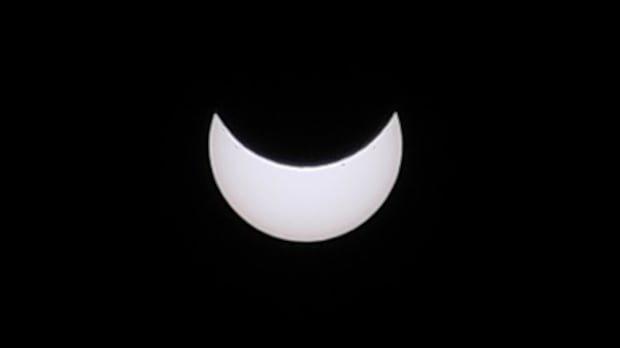

On Wednesday afternoon, residents of Newfoundland and Labrador had the opportunity to witness a partial solar eclipse, depending on the weather conditions. The partial eclipse began in Churchill Falls at 1:37 AT (2:07 NT) and gradually spread across the province, ending in St. John’s at 4:37 p.m. NT. In Newfoundland, the moon was projected to cover around 50% of the sun, with varying degrees of visibility based on location.
Enthusiastic spectators gathered at the Johnson Geo Centre in St. John’s to observe the moon passing in front of the sun through telescopes equipped with special safety viewing glasses. The event, which was held from 12 p.m. NT to 5 p.m., was organized in collaboration with the Royal Astronomical Society of Canada and STEM Girls.
Astronomer Hiding Neilson from Memorial University expressed his awe at watching the moon gradually obscure the sun through a telescope, highlighting the rarity of the event which occurs approximately every 50 years. Neilson emphasized the uniqueness of solar eclipses on Earth compared to other planets in our solar system.
Ahead of the eclipse, Andrea van Nostrand, the lead of education and interpretation at the Geo Centre, mentioned that activities such as creating solar viewing tools for children were planned to ensure safe viewing of the phenomenon. Van Nostrand described the experience of witnessing the eclipse as “spectacular” and emphasized the importance of using protective gear when observing the sun.
Total solar eclipse enthusiasts Jennifer Waye and Gabriela Fuentes Waye, who had previously witnessed a total eclipse, traveled to Spain to experience the event once again due to its beauty and the favorable weather conditions. In Canada, regions further north and east, including Alert, Nunavut, were expected to have a clearer view of the more complete solar eclipse, with the sun estimated to be 94% covered.
The celestial event captivated onlookers with its awe-inspiring display, reinforcing the wonder and fascination that solar eclipses evoke among skywatchers.