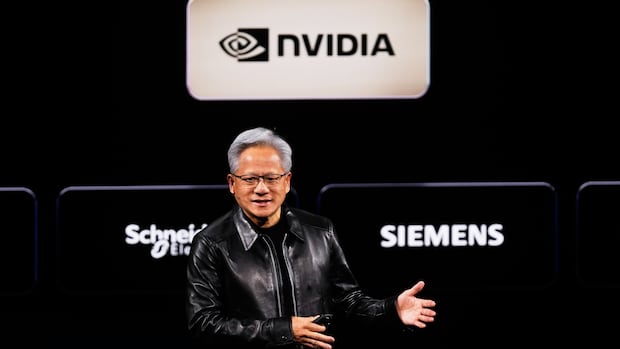
The disclosure regarding Nvidia’s CEO Jensen Huang having an extramarital relationship with a former executive from a Singaporean firm has intensified worries about China’s access to advanced microchips that are restricted from entering the country.
Huang has acknowledged his affair with Alice Huang, a Chinese entrepreneur who subsequently became the principal shareholder of Megaspeed International, a cloud-computing enterprise based in Singapore.
According to a report from The New York Times last month, U.S. officials determined that Alice Huang was a Chinese intelligence operative, allegedly transmitting sensitive information to Beijing while fostering a close relationship with the Nvidia CEO—claims that China’s Foreign Ministry has dismissed as “baseless.”
Megaspeed has also come under scrutiny from U.S. regulators amid suspicions that it facilitated access to advanced Nvidia chips for Chinese firms, which are subject to export restrictions imposed by Washington.
As the controversy unfolds, it has highlighted the effectiveness of U.S. measures restricting these advanced chips from reaching China.
This article explores the reasons behind China’s demand for these high-end chips, the rationale behind the U.S. export bans, and the methods by which China continues to obtain them.
What motivates China to seek Nvidia’s chips?
Nvidia is recognized for designing some of the most potent AI chips globally, regarded as the benchmark in the industry, according to analysts.
“Their chips are leading the way in the AI revolution,” stated Ryan Ellis, an associate professor at Northeastern University in Boston, focusing on communication law and policy, infrastructure politics, and cybersecurity.
Artificial intelligence demands substantial graphics processing unit (GPU) resources, as noted by Dennis Wilder, a former senior intelligence officer and director for China at the National Security Council.
High-performance chips, like those from Nvidia, offer a cost-effective solution for AI development, eliminating the need to establish additional data centers for increased GPU capacity, Wilder explained.
These chips also enable the most sophisticated AI models, according to Ellis, indicating that a lack of access to such technology stifles progress.
“There is a tremendous appetite for these chips within China,” he remarked. “A thriving black market exists for the most advanced video chips there.”
Why has the U.S. prohibited sales of these chips to China?
In October 2022, during the Biden administration, the U.S. Department of Commerce enforced export controls on advanced computing chips destined for China. Consequently, Nvidia’s leading chips, Blackwell Ultra and Vera Rubin—both GPUs utilized for AI applications—are barred from being sold to Chinese entities.
The U.S. government cites two primary objectives for this ban: to maintain its global leadership in AI innovation and to safeguard national security.
Whoever leads the AI race and can develop the most effective models will have significant influence in the upcoming phase of the AI transformation, according to Chris Mattmann, the first chief data and AI officer at UCLA.

Nvidia shares dropped sharply after the U.S. tech giant launched an investigation into CEO Jensen Huang’s affair with a Chinese woman who U.S. intelligence agencies allege is a spy for Beijing.
While the U.S. currently maintains an edge over China, Mattmann warns that this gap is narrowing. Any developments that could “shift the balance,” such as access to advanced chips, could further close this divide.
The U.S. government also aims to uphold national security, fearing that granting China access to these chips might enhance its military capabilities, potentially leading to advanced systems that could threaten American interests.
“Export controls aim to foster market growth while ensuring that national security is not compromised,” Ellis noted.
However, U.S. President Donald Trump has relaxed certain restrictions, allowing the sale of other Nvidia chips, typically used in consumer electronics, to China under specific conditions.
How is China still acquiring Nvidia chips?
Following the implementation of advanced chip restrictions, a network for illegal smuggling and underground sales emerged, allowing vendors to funnel chips into China for resale, as reported by Germany’s Deutsche Welle (DW) news agency.
The U.S. has been cracking down on these vendors wherever feasible. In December 2025, the Department of Justice announced the arrest of two Chinese individuals accused of smuggling Nvidia chips into China.

A screengrab from CTI video footage shows a woman identified by Reuters as Alice Huang, after comparison with a photograph obtained separately, attending a dinner with Nvidia CEO Jensen Huang at a restaurant in Taipei, Taiwan, on May 22, 2025. (Reuters)
Additionally, a legal loophole exists that can be leveraged to facilitate chip shipments to China.
Although Nvidia is prohibited from selling its most advanced chips directly to China or its companies, it can sell them to other nations, and third-party data centers can offer access to those resources to Chinese-affiliated firms.
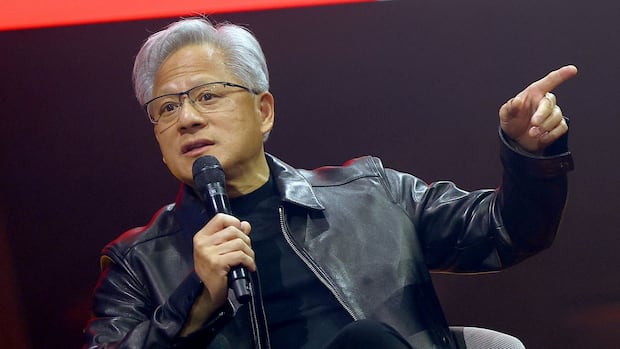
Nvidia is opening an investigation into its CEO, Jensen Huang, after he admitted to having an affair. The woman in question is accused of being a Chinese spy, having allegedly passed information to Beijing, according to a media report. New York Times reporter Julian E. Barnes, who broke the news of Huang’s relationship, says ‘there is a long way to go on this story.’