
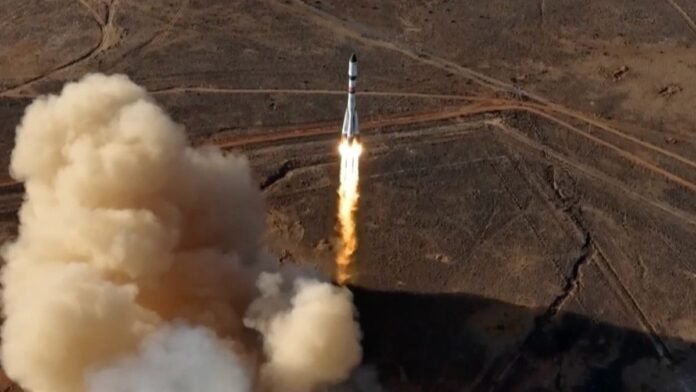

Russia has implemented a lockdown in a significant area near NATO territory due to concerns about potential “missile” impact. Ships and aircraft have been instructed to avoid large portions of the Barents Sea ahead of an upcoming space launch. These restricted zones, located north of Norway’s Varanger and Bear Island, will be off-limits until April 30, a longer-than-usual safety precaution for the region.
The mention of “missiles” in this context is customary Russian terminology for rocket launches, where discarded space rocket components are officially labeled as “missile elements.” In this instance, the caution is connected to a Soyuz-2.1b launch scheduled from the Plesetsk Cosmodrome, anticipated around April 23. As the rocket progresses, sizeable metal structures known as payload fairings will be discarded and descend back to Earth, with two expected to land in the designated areas.
Notifications were disseminated via aviation and maritime safety systems, advising seafarers to steer clear of the restricted zones during the launch period. The mission is set to transport a group of Rassvet broadband satellites, part of Vladimir Putin’s initiative to establish a low-orbit internet network as a competitor to systems like Elon Musk’s Starlink. The Barents Sea, renowned for being one of the world’s most abundant fishing grounds, partially lies within Norwegian waters, making the extended exclusion zones noteworthy for shipping and fisheries.
Meanwhile, in Ukraine, Russian strikes targeted over half a dozen areas beyond the front line on Tuesday and Wednesday. Tragically, an eight-year-old boy lost his life in the central Cherkasy region, and a woman was injured in southern Zaporizhzhia, as reported by Ukrainian President Volodymyr Zelensky and local authorities.
Zelensky expressed urgency, stating, “Every day we need air defence missiles – every day Russia continues its strikes,” via a post on the Telegram messaging app. With no additional US-mediated talks with Russia on the horizon, Zelensky embarked on visits to three European capitals within 48 hours to secure commitments of further military and financial backing.
German and Ukrainian officials reached an agreement on a defense package valued at four billion euros, while Norway pledged nine billion euros in support, according to Ukrainian sources. Ukraine possesses battle-tested drone interception expertise and has made strides in air defense technology, yet lacks the resources to scale up production to fully leverage its capabilities.