
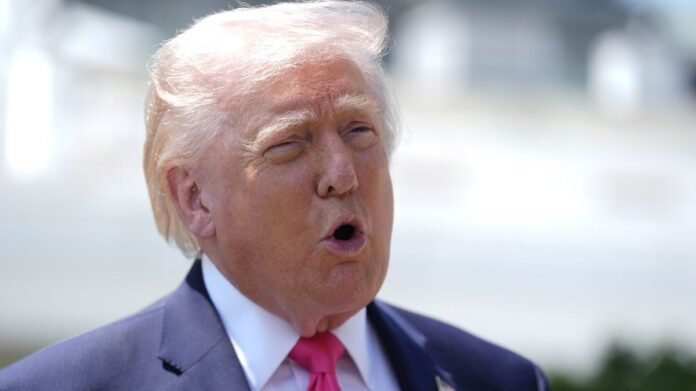

President Donald Trump issued a stark nuclear warning to Pope Leo today and declined the opportunity to meet with the pontiff. Speaking to the press outside the White House before his departure on Marine One, Trump addressed questions regarding Iran, the Israel-Lebanon ceasefire, and the possibility of a meeting with the Pope in light of their recent public disagreement.
Earlier in the day, Pope Leo criticized “tyrants” for spending vast sums on warfare globally. Trump emphasized the importance of the Pope understanding the severity of Iran’s actions, pointing out the casualties of 42,000 unarmed individuals. He asserted that Iran must not possess nuclear weapons and insisted that the Pope comprehend this stance. When asked about reconciling with the Pope, Trump dismissed the idea as unnecessary.
Regarding concerns about upsetting his Catholic supporters, Trump maintained that he believed he was acting in accordance with what he deemed right. While affirming that he bore no personal animosity towards the Pope, Trump asserted his right to disagree with the pontiff’s views. He also mentioned his acquaintance with the Pope’s brother and proudly declared his unwavering support for the “MAGA” (Make America Great Again) agenda.
The escalating feud between Trump and the Pope has seen the US president criticize the pontiff for his stance on the Iran conflict, while the Pope has expressed a lack of fear towards the Trump administration. Trump previously lambasted Pope Leo as being weak on crime and foreign policy, stating his disapproval of the Pope’s positions.
In response to Trump’s criticisms, the Pope delivered a message emphasizing God’s alignment with the humble and the loving, contrasting with the arrogance and pride of warmongers. In a separate instance, JD Vance challenged the Pope’s assertion that God does not support those who engage in warfare, citing a historical tradition of just war theory spanning over a millennium.
During a speech at a Turning Point USA event at the University of Georgia, Vance acknowledged the potential for differing opinions on the justifiability of various conflicts.