
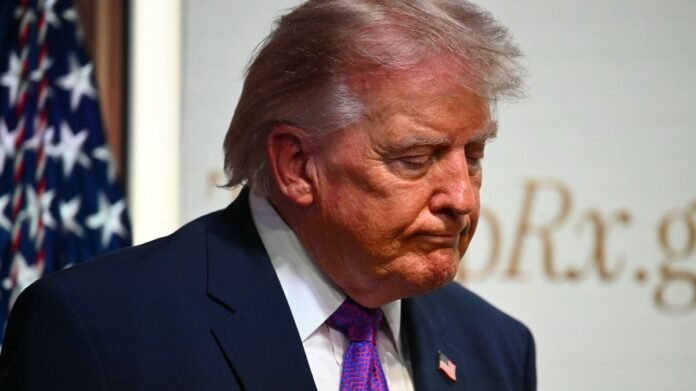

Donald Trump is facing a situation of humiliation from Iran as the ongoing Middle East conflict shows no signs of resolution, potentially leading to significant consequences for the US President, according to a foreign policy expert. Trump revealed that he instructed US forces to postpone a planned attack on Iran to facilitate supposed negotiations among leaders. His focus has shifted from overthrowing Tehran’s regime and crippling its military to preventing Iran from obtaining nuclear weapons.
However, Trump’s flawed military strategies have led to what security and defense expert professor Anthony Glees describes as a “strategic defeat” for Trump, despite early air strikes that targeted the Ayatollah. Iran’s move to block the critical Strait of Hormuz oil shipping route not only caused a spike in oil prices but also showcased to China that the US’s ability to intervene is limited.
Glees pointed out that this scenario has not only been a setback for Trump and the US but has also underscored the constraints of American power to the world, especially to Iran and its ally, China’s President Xi-Jinping. The conflict in Iran has garnered widespread disapproval in the US and globally, with a majority of American voters, including a significant portion of Republicans, believing that Trump’s decision to engage in war was wrong.
Trump’s popularity has taken a hit in recent months due to the prolonged conflict, as indicated by a New York Times/ Siena poll showing his approval rating dropping to a low of 37%. Amid declining support, Trump announced via TruthSocial that discussions for a potential deal were underway with leaders from Qatar, Saudi Arabia, and the UAE to avoid military action against Iran.
The financial toll of the war, estimated at $29 billion, coupled with Trump’s eagerness for an exit strategy, led to significant concessions to political adversaries, potentially with far-reaching implications. Despite Trump’s claims of an impending agreement, the conflict remains unresolved, with Glees suggesting that a conclusive resolution may require ground troops, a proposition widely opposed by many Americans.
The closure of the previously freely accessible Strait of Hormuz, now a potential toll route controlled by Iran, reflects the Iranian regime’s commitment to resisting the US. Trump’s recent announcements of progress in negotiations have momentarily stabilized stock markets, yet his communication approach has been criticized for its aggressive and inconsistent tone, undermining his credibility and portraying weakness in the eyes of Iran.
As the conflict lingers, Iran appears to exploit Trump’s perceived vulnerabilities, further complicating the situation.