

On the horizon is the upcoming solar eclipse, set to be the most striking one visible from the UK in over two decades, since the year 1999. As the event draws near, many enthusiasts may be curious about safe viewing methods.
Fortunately, individuals can indeed witness the spectacle safely by utilizing specialized glasses designed for eclipses, among other ways to enjoy the celestial show without risking harm to their eyes.
Scheduled for Wednesday, August 12, residents across a significant part of Europe, including the UK and Ireland, will have the opportunity to observe a remarkable partial solar eclipse, with the Moon obscuring approximately 90% of the Sun’s surface.
Meanwhile, a total solar eclipse, where the Moon entirely blocks the Sun, will be visible from select regions such as Spain, Greenland, Iceland, northern Russia, and a small portion of northern Portugal.
The specific timing of the eclipse will vary based on location. In cities like London, Bristol, and Cardiff, the eclipse is expected to commence around 6:17 pm, reach its peak at about 7:12 pm, and conclude around 8:06 pm, according to the Royal Museums Greenwich.
Those in Cornwall can anticipate around 95% coverage around 7:16 pm, with the southwest region poised to witness the most extensive eclipse display in the UK, according to the Royal Observatory Greenwich.
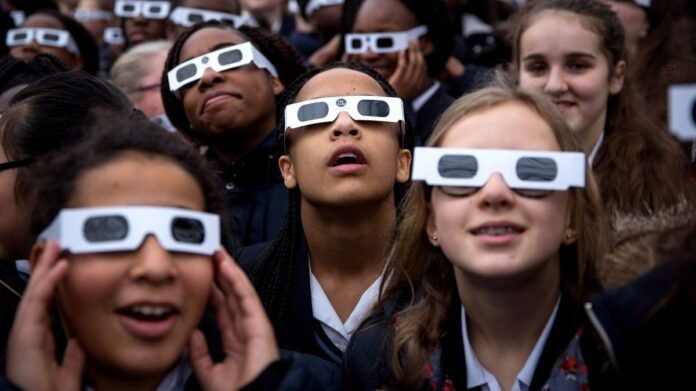
It is crucial to use specially designed eclipse glasses or handheld solar viewers when observing a solar eclipse, as these tools are significantly darker than regular sunglasses, as highlighted by NASA, emphasizing the importance of eye protection during such events.
The UK Health Security Agency (UKHSA) has issued a cautionary advisory against looking directly at the Sun during an eclipse without proper eye safeguarding, as it can lead to severe eye damage.
During a solar eclipse, the sky darkens, and the Sun may appear less radiant, potentially encouraging prolonged staring. However, even the remaining visible portion of the Sun emits powerful ultraviolet, visible, and infrared radiation, posing a risk of retina damage, as warned by the UKHSA.
Following the 1999 total solar eclipse, the Royal College of Ophthalmologists documented around 70 cases of individuals experiencing vision issues. Alarmingly, about 40% of those affected had viewed the eclipse for less than a minute.
Moreover, NASA advises against looking at the Sun through devices like camera lenses, telescopes, binoculars, or any other optical instrument, even when wearing eclipse glasses or using handheld solar viewers.
For those without access to eclipse glasses, several cost-effective methods utilizing common household items can enable safe viewing of the phenomenon, as suggested by the UKHSA.
Alternatively, viewers can opt for online viewing options. The European Space Agency will broadcast a live webcast from Spain’s Astrophysical Observatory of Javalambre, complemented by a public event in León. NASA and the Italy-based Virtual Telescope Project will also provide coverage, among other platforms.
Stay informed with Daily Mirror as a ‘Preferred Source’ on Google News for timely updates on the stories that matter to you.