
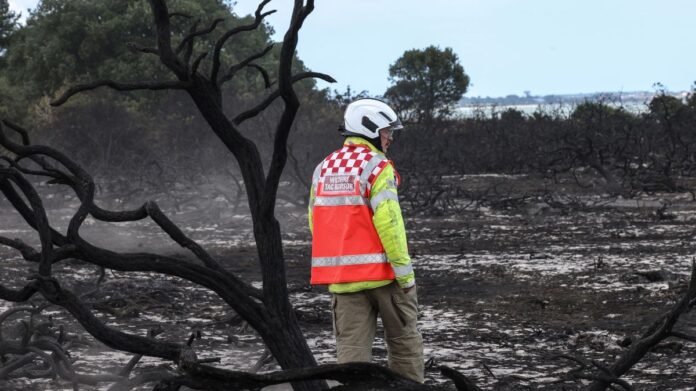

Rare wildlife habitats in the UK that have been severely affected by the recent heatwave may require up to 25 years to fully recover, according to conservation experts.
The forecast of cooler temperatures across many regions of the UK could potentially alleviate the strain on firefighters. Nonetheless, emergency crews have been actively responding to numerous grassland fires spanning from the Snowdonia National Park to Suffolk, following the driest July on record in England and Wales.
Concerns have been raised by campaigners and government officials about the likelihood of extreme weather conditions becoming more frequent due to global warming. Recent images have revealed extensive damage in Sychnant Pass in North Wales, where hundreds of acres of land were decimated last month.
Following a major incident declaration when flames engulfed Conwy Mountain, forcing the evacuation of 36 residences due to a rapidly spreading fire on July 12, dramatic photos now depict vast areas of charred terrain.
The Sychnant Pass encompasses parts of Snowdonia National Park, a designated Site of Special Scientific Interest. The North Wales Fire and Rescue Service (NWFRS) has urged the public to refrain from visiting affected areas, as some individuals have been traveling to wildfire sites to capture aerial footage, potentially hindering firefighting efforts.
Mountain rescue teams have observed an uptick in visitors to impacted regions engaging in ‘wild camping,’ a practice deemed hazardous and straining resources while impeding emergency access and firefighting operations. Authorities have advised against using disposable barbecues, ensuring cigarette disposal is safe, taking litter home, and refraining from leaving glass bottles behind to mitigate wildfire risks.
England and Wales are on track to experience the driest July on record, characterized by an extraordinary combination of extreme heat, abundant sunshine, and minimal rainfall, as reported by the Met Office. Preliminary data indicates that England received only 5.6mm of rain in July, significantly lower than the previous record set in 1911. Similarly, Wales recorded just 7.9mm of rainfall, nearly a third of the previous record established in 1911, resulting in widespread drought conditions and over 24 million individuals facing hosepipe bans.
The most severe blaze occurred at Dunwich Heath in Suffolk, where firefighters successfully contained the fire. The loss of a critical habitat for some of the UK’s rarest species at this location was described as devastating by National Trust’s director-general, Hilary McGrady. Furthermore, Adam Rowlands, the RSPB’s area manager in Suffolk, expressed concerns that the habitats ravaged by the fire may necessitate up to 25 years for full recovery, emphasizing the profound impact on wildlife.
The ongoing drought conditions have raised concerns about potential food shortages in the UK. National Farmers’ Union (NFU) President Tom Bradshaw highlighted the challenges faced by farmers, noting poor yields of wheat and oats this year, prompting livestock farmers to deplete their winter feed reserves due to inadequate grass growth.
Bradshaw stressed that high temperatures and drought have placed significant strain on all farming sectors, with vegetable producers grappling with water scarcity, reducing food production and escalating cultivation costs. He advocated for tax incentives to support farmers in constructing water storage systems to prepare for future challenges, emphasizing the critical interplay between water security, food security, and national well-being.
As drought conditions persist across substantial areas of England and Wales, with over 20 million people affected by hosepipe bans, the UK Health Security Agency has issued amber heat health alerts for various regions until early August. Heightened heat health alerts have been issued for the East Midlands, East of England, London, and the south-east, underscoring the urgent need for public awareness and preparedness during extreme weather conditions.
The prevailing circumstances underscore the imperative for proactive measures to address water scarcity and enhance food security in the face of evolving climatic challenges, emphasizing the need for sustainable resource management practices to safeguard national food supplies and mitigate future risks.