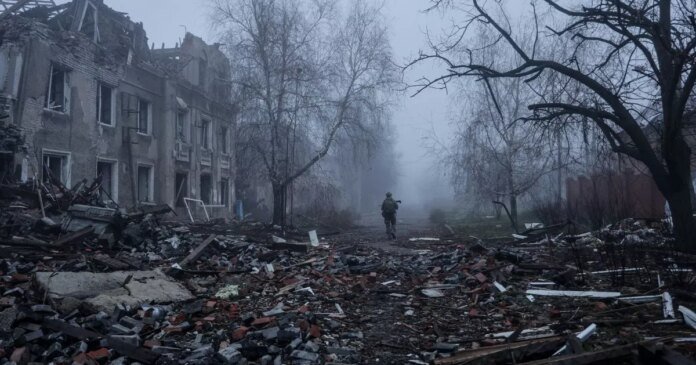

In a recent development, a prominent US think tank has refuted Russia’s claims of an imminent victory over Ukraine. The think tank’s analysis highlights the significant costs Russia is incurring during its prolonged battle for the key town of Pokrovsk, despite asserting its advances for three months.
Russian military leaders are reportedly striving to portray a false image of success to sway Western powers and coerce Ukrainian concessions. Concurrently, an unnamed NATO official has cautioned Russia about potential preemptive actions by the alliance. Additionally, Michael McGrath, the European commissioner for justice and democracy, has opposed a US peace proposal that would grant amnesty to Russian war criminals.
Tragically, a missile strike by Russia in central Ukraine’s Dnipro region has resulted in the deaths of at least four individuals, as diplomatic efforts to end the conflict escalate. Russian President Vladimir Putin is scheduled to meet with US envoy Steve Witkoff in Moscow, as confirmed by the Kremlin.
Contrary to Kremlin assertions, the ISW report debunks claims of Russia’s impending victory in the Ukrainian conflict. It suggests that Putin aims to demonstrate to President Trump a weakening Ukrainian war effort to coerce compliance with Russian demands. The ISW report underscores the vulnerabilities in Russia’s military campaign that have yet to be exploited by Western powers.
Furthermore, the report challenges Kremlin spokesperson Dmitry Peskov’s allegations of worsening conditions on Ukraine’s battlefield and internal fronts. Peskov’s accusations against the Ukrainian government for obstructing peace talks are disputed by the ISW report, which exposes a Kremlin propaganda campaign to create urgency and pressure Ukraine and the West into conceding to Russian demands prematurely.
Acknowledging Russia’s recruitment setbacks, even pro-Kremlin war commentators have admitted to manpower shortages and the challenges faced by Russian forces in sustaining their operations in Ukraine. Despite some critical sectors on the front line, such as Pokrovsk and Hulyaipole, facing heightened tensions, the ISW stresses that Russia’s narrative of an inevitable victory is unfounded based on the current battlefield realities.
The prolonged and arduous Russian campaign to capture Pokrovsk has not resulted in a complete takeover, with Russian forces encountering obstacles in advancing due to their strategic limitations. The report emphasizes that Russia’s slow progress and failure to secure Pokrovsk entirely after more than 120 days of occupation contradict the Kremlin’s portrayal of an imminent victory.