
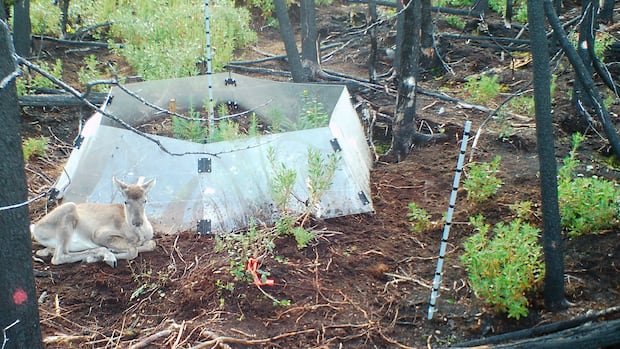

Lucas Brehaut anticipated significant interest in his study, but the attention he received from the wildlife in Newfoundland’s wilderness turned out to be more than he bargained for. Various animals, including caribou, moose, black bears, wolves, rabbits, and owls, took a keen interest in his research equipment, causing damage and disruptions.
As a wildfire research scientist with the Canadian Forest Service, Brehaut is investigating forest regeneration in Atlantic Canada post wildfires. Despite the cooler and wetter climate of the region, forest fires are becoming more frequent. Following a forest fire near Grand Falls-Windsor, N.L., in 2022, Brehaut embarked on a study to understand forest regrowth in a warming world due to climate change.
Using 19 open-top chambers (OTCs) resembling mini greenhouses, Brehaut’s team placed them around planted seedlings to simulate temperature increases of up to three degrees, replicating the effects of a warming planet. However, the wildlife intrusions, documented via cameras initially set up for snow depth monitoring, caused disruptions and damages to the equipment at 11 out of 19 sites.
Despite facing challenges such as harsh terrain and adverse weather conditions in Newfoundland, Brehaut had not anticipated the extent of interference from animals like caribou, moose, and bears. Some animals not only trampled the greenhouses but also made off with temperature sensors, creating setbacks in the research progress.
While Brehaut recognized the disruptions caused by the wildlife, he maintained a positive outlook, acknowledging that animals were merely curious inhabitants of their natural habitat. The interference from animals, while hindering research efforts, was seen as a part of the interaction between humans and wildlife in their shared environment.
Kaitlyn Gaynor, an assistant professor at the University of British Columbia, explained that animals’ curiosity towards novel objects in their environment, driven by the search for food or threat assessment, was a natural behavior. This curiosity, especially in intelligent animals like bears, was attributed to their omnivorous nature and evolutionary advantage of exploring new resources.
Gaynor highlighted the importance of minimizing human scent on research equipment to reduce animal attraction and interference. She shared her experiences of animal disruptions during fieldwork in Mozambique, emphasizing the challenges posed by animals like baboons, hyenas, and elephants, which often interacted with or damaged research equipment.
In conclusion, while wildlife interference in research activities is a global phenomenon, researchers like Brehaut and Gaynor adapt their methods to coexist with the natural curiosity and behaviors of animals, recognizing the invaluable insights gained from studying wildlife interactions with scientific equipment.