
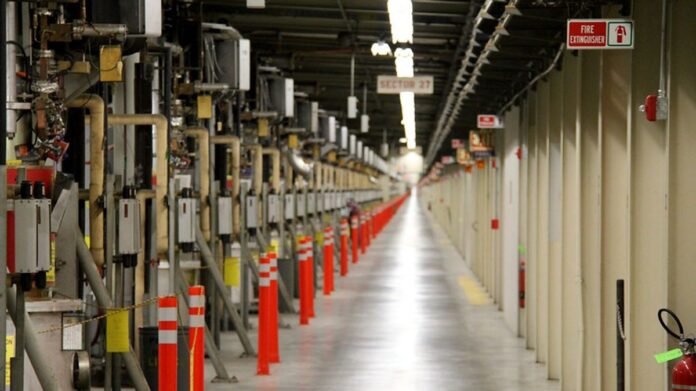

A remarkable two-mile-long structure holds the title of the world’s longest building, with its immense size necessitating consideration of the Earth’s curvature for accurate measurement. The Klystron Gallery, situated at the SLAC National Accelerator Laboratory near Menlo Park, California, spans an impressive 3,073 meters (1.9 miles), requiring approximately 35 to 40 minutes to walk from one end to the other at a moderate pace. Notably, the structure’s vastness allows it to be visible even from space.
Constructed as a crucial component of a significant scientific endeavor in the 20th century, the Klystron Gallery serves as a pivotal element of the Stanford Linear Accelerator project, aimed at studying particle collisions to reveal insights into matter’s composition. The original project incurred a cost of around $114 million in the 1960s, with an additional $18 million allocated for research and development, totaling approximately $132 million (£98 million) at that time, equivalent to £1.6 billion today when adjusted for inflation.
The heart of the site is the Klystron Gallery, a sprawling industrial building housing a two-mile underground particle accelerator. Unlike conventional structures like skyscrapers or shopping malls, this building is dedicated to powering one of the world’s longest linear accelerators. The gallery accommodates arrays of klystrons, high-powered microwave amplifiers crucial for generating radiofrequency energy to accelerate electrons within the underground tunnel to nearly the speed of light.
Internally, the gallery presents an expansive industrial corridor with extended sections of machinery, electronic units, and service zones stretching far into the distance, creating a visually surreal effect in photographs. The extraordinary length of the building was intentionally designed to meet the demanding spatial requirements of particle accelerators, necessitating significant distances to propel particles to high energies steadily. Surveyors meticulously considered the Earth’s curvature during the alignment process to maintain precise beam trajectories across the extensive two-mile span.
Established in 1962 and currently managed by Stanford University on behalf of the U.S. Department of Energy, SLAC is a distinguished research facility renowned for its contributions to various scientific disciplines such as particle physics, astrophysics, and materials science. The laboratory has been associated with multiple Nobel Prize-winning discoveries, with sections of the original accelerator now powering the Linac Coherent Light Source, a cutting-edge X-ray laser system.
While the Klystron Gallery was long considered the world’s longest modern building, defining the “world’s longest building” proves intricate due to differing categorizations based on continuous enclosed structure, total length, floor area, or intended use. The debate was further complicated in 1999 with the completion of the LIGO observatories, featuring extensive interferometer arms exceeding the length of the Klystron Gallery, though their specialized scientific nature raises questions on their classification.
In comparison, the New Century Global Center in Chengdu, China, often hailed as the world’s largest building, boasts vast floor space but falls short in length when compared to the Klystron Gallery. The structural enormity of the gallery can be visualized by equating its length to approximately 30 football fields placed end to end, making it a distinctive landmark visible from the air across California’s landscape.
The Klystron Gallery’s unique status as a mammoth scientific facility rather than a conventional commercial or residential structure underscores its significance as a monumental scientific hub dedicated to unraveling the mysteries of the universe. The ongoing debate over the world’s longest building arises from varying interpretations of the criteria for such a designation, with structures like the Great Wall of China excluded due to their defensive fortification classification, highlighting the distinctiveness of the Klystron Gallery’s design and purpose.