
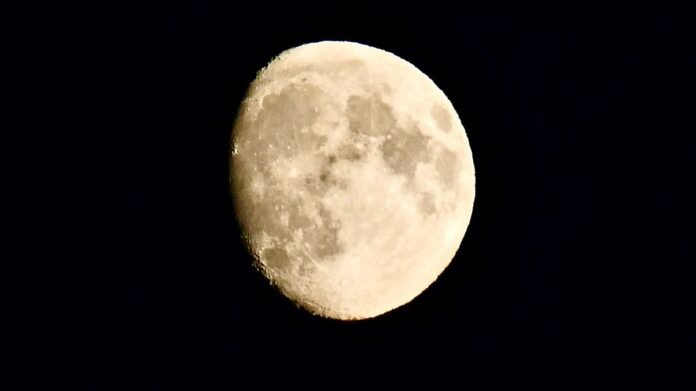

A SpaceX rocket is currently moving towards a collision with the Moon, with a potential flash visible from Earth upon impact. The rocket’s upper stage, equivalent in size to a five-story building, is expected to strike the Moon on Wednesday, creating a crater and ejecting dust and debris.
Initially launched by SpaceX last year as part of a joint US-Japanese mission carrying lunar landers and scientific gear, the Falcon 9 rocket’s abandoned segment, measuring about 40 feet and weighing around 10,000 pounds, is set to crash into the Moon. Experts suggest that this collision could have been avoided by redirecting the upper stage into a solar orbit.
Space-tracking specialist Bill Gray forecasts that the rocket will hit the Moon at a speed of approximately 5,400 miles per hour, significantly faster than the speed of sound. Gray anticipates the impact to occur near the Einstein Crater on the Moon’s illuminated western side.
While the actual collision event may not be visible from Earth, astronomers speculate that the impact flash, lasting less than a second, could be observable through high-powered telescopes. Additionally, the resulting plume of dust and debris is expected to be more visible, potentially extending several miles above the lunar surface and remaining observable through telescopes for an extended period.
Astronomer Bill Gray, who initially identified the rocket’s trajectory towards the Moon, mentioned on his Project Pluto website the possibility of observing the impact flash and ejected rocks from the crater. Dr. Matt Bothwell, a public astronomer at the University of Cambridge, indicated that individuals with sophisticated telescopes may witness a flash emanating from the Moon’s surface.
Observers in the eastern US and Canada, as well as much of South America, are likely to have the best vantage points for observing the event. Despite minimal concerns regarding this specific space debris piece, scientists emphasize the escalating threat posed by the increasing congestion in orbit.
Gray highlighted the overcrowded space environment and intends to observe the aftermath from New Brunswick, Canada. This incident marks the second time a discarded rocket has unintentionally collided with the Moon, following a similar event involving a Chinese rocket segment in 2022.
Benjamin Fernando from Los Alamos National Laboratory expressed interest in assessing the potential hazards of debris impacts on future space missions. Fernando anticipates the creation of a crater approximately 90 feet wide and 16 feet deep as a result of the impact, visible to spacecraft but too small to be seen from Earth.
Astrophysicist Jonathan McDowell noted that while this impact is not a significant concern, similar events could pose challenges in a future scenario with long-term Moon bases. McDowell emphasized the importance of avoiding leaving rocket stages in unstable orbits to prevent potential issues.
Remember to select Daily Mirror as a ‘Preferred Source’ on Google News for convenient access to valued news updates.