
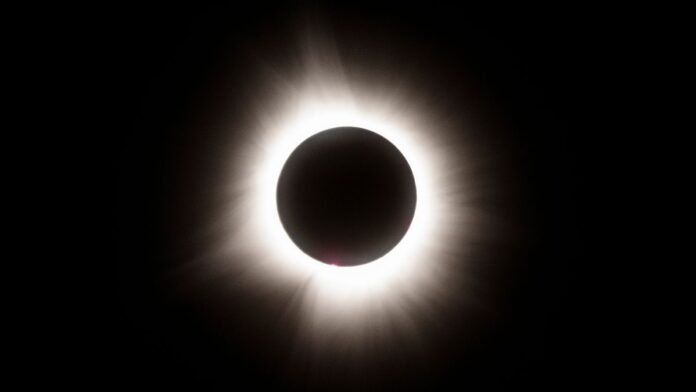

Europe is gearing up for its first mainland total solar eclipse in over two decades, set to occur on Wednesday, August 12. The celestial event will involve the Moon passing between the Sun and Earth, causing parts of the Northern Hemisphere to experience varying degrees of solar obstruction. While a total solar eclipse will be visible in regions like northern Spain, parts of Portugal, Greenland, Iceland, Russia, and the Atlantic Ocean, other areas including the UK, Europe, Canada, the northern US, and north-west Africa will witness a partial eclipse, with London expecting up to 90% coverage.
Enthusiasts within the narrow “path of totality” will witness a mesmerizing view as the Moon completely obscures the Sun, creating a brief period of darkness and revealing the Sun’s corona. The European Space Agency estimates this phenomenon will last up to one minute and 40 seconds. Although total solar eclipses occur globally every 18 months, this event holds particular significance as it marks the first visible eclipse from mainland Spain in over a century and the most profound eclipse visible from the UK since 1999.
Detailed information provided by the European Space Agency indicates the specific regions in Spain and Portugal that will witness the total eclipse. Notably, the Balearic Islands, including Majorca, are also within the path of totality, with the eclipse expected to last for 96 seconds starting at 8.31pm CEST. Visitors are encouraged to witness this extraordinary event from their accommodations or nearby open spaces to reduce unnecessary travel and protect environmentally sensitive areas.
In addition to Spain and Portugal, parts of Iceland and Greenland will experience the total eclipse. While the UK and Ireland will not fall within the path of totality, regions such as Cornwall, Pembrokeshire, and the south-west coast of Ireland are expected to witness significant eclipse coverage ranging from 94% to nearly 97.5%. For instance, the Dingle Peninsula in County Kerry is highlighted as one of the best viewing spots in Ireland. Cork Beo reports that experts anticipate exceptional views in this area.
As anticipation builds for this rare astronomical event, experts and enthusiasts alike are preparing to witness the remarkable display of the Moon passing in front of the Sun, creating a spectacle that captivates viewers across the Northern Hemisphere.