
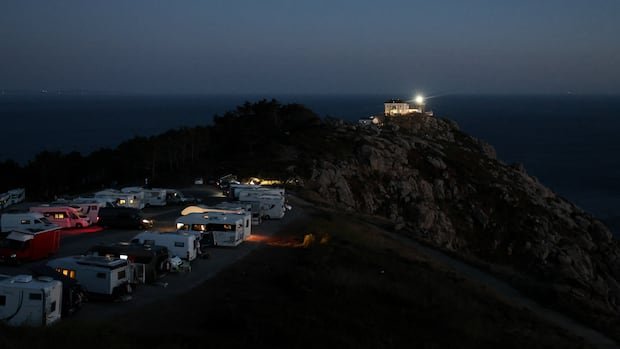

Hundreds of thousands of visitors have flocked to Spain to witness the solar eclipse on Wednesday. However, the event coincides with high temperatures and an increased risk of wildfires across the country, raising concerns for authorities keen on preventing any fire damage resulting from the surge in astrotourism.
Virginia Barcones, the secretary general for civil protection and emergencies at Spain’s Interior Ministry, emphasized the need to curb activities that could potentially spark wildfires, especially in the wake of a challenging summer marked by significant forest fires. Spain has been grappling with an intense heatwave since May, exacerbating the ongoing wildfire season. According to the European Forest Fire Information System, approximately 603,000 acres of land have already been scorched in nearly 400 fires this year.
To mitigate the risk of additional fires during the eclipse, authorities are mobilizing 35,000 officers to monitor large outdoor gatherings and swiftly address any potential fire incidents, as highlighted by Barcones. Spain stands out as a prime spot for viewing the solar eclipse, with the narrow totality band spanning across northern Russia, eastern Greenland, western Iceland, and parts of Spain, including the Balearic Islands.
Only regions within the path of totality will witness the complete obscuration of the sun by the moon. In Canada, a partial eclipse will be observable, with Newfoundland expected to witness the most coverage. Viewers are reminded to use proper eclipse glasses for eye protection. This rare solar eclipse marks the first time in 120 years that mainland Spain will experience a full eclipse, fueling a surge in travel interest.
Special measures have been put in place by Spanish authorities to manage the influx of tourists expected for the eclipse, with a notable spike in accommodation searches along the path of totality. Regional governments have designated 660 official viewing sites to accommodate over 440,000 anticipated visitors, with an estimated 1.5 million people projected to travel to these sites. Authorities caution against fire risks, urging tourists to refrain from using barbecues and venturing into dry, fire-prone areas.
Despite the prevailing heatwave and wildfire concerns, the enthusiasm for the eclipse remains high among travelers. Professor Jan Cami from the University of Western Ontario underscores the universal appeal of celestial events, emphasizing the awe-inspiring spectacle of nature. The eclipse is forecasted to contribute significantly to Spain’s economy, with an estimated impact of over 347 million euros, as per a recent economic study.
Dry conditions and heightened fire risks persist across the Iberian Peninsula and the Balearic Islands, with the forest fire index expected to reach critical levels on eclipse day. The extreme dryness in Spain, compounded by the lack of rainfall, poses significant fire hazards. The forthcoming solar eclipses in the coming years are anticipated to further drive astrotourism, offering unique opportunities for travelers to witness these celestial phenomena in different parts of the world.