
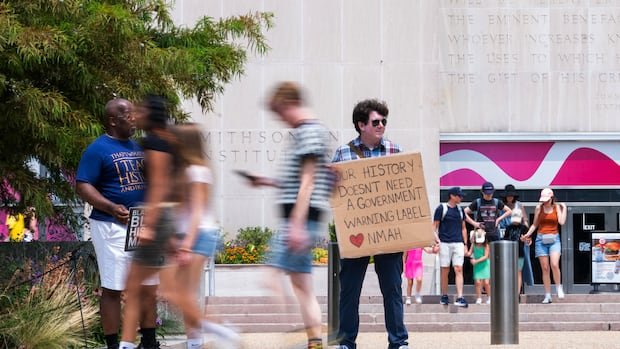

The Smithsonian’s National Museum of American History in Washington, D.C., attracts visitors worldwide to view iconic artifacts like Dorothy’s red slippers from the Wizard of Oz, U.S. first ladies’ inaugural gowns, and the Star-Spangled Banner. Recently, the museum has become a focal point of controversy, with protesters outside expressing concerns about historical narratives.
Observers suggest that the Trump administration’s actions reflect a broader strategy to influence the storytelling in U.S. cultural institutions. This effort is seen as part of a long-term conservative initiative to align exhibits with certain values and reduce the influence of independent experts.
President Trump’s directive to post signs at the museum warning of potential inaccuracies inside stems from a 162-page White House report on America’s 250th anniversary. The report criticizes the museum’s leadership for alleged political activism and promoting narratives of shame and division over celebratory and patriotic themes.
Trump’s past criticisms of the Smithsonian for focusing on negative aspects of American history have fueled ongoing reviews of the institution’s programs and exhibits. The Smithsonian, as the world’s largest museum system, houses millions of historical items, including significant cultural artifacts.
In response to the White House report, the Smithsonian has defended its scholarly approach to presenting America’s story comprehensively. Amid concerns about political interference, the institution has stood firm in upholding its mission despite external pressures.
The Smithsonian’s resilience against political scrutiny has garnered praise from supporters, highlighting the institution’s commitment to maintaining curatorial independence. Public sentiment shows a majority across political divides supporting the Smithsonian’s autonomy in preserving historical narratives.
As debates continue over the museum’s portrayal of American history, visitors like Amy Carlson Miesel and student Tan Tran reflect on the diverse perspectives presented. While some critique the museum for perceived ideological bias, others appreciate the range of historical narratives, acknowledging the complexity of America’s past.