
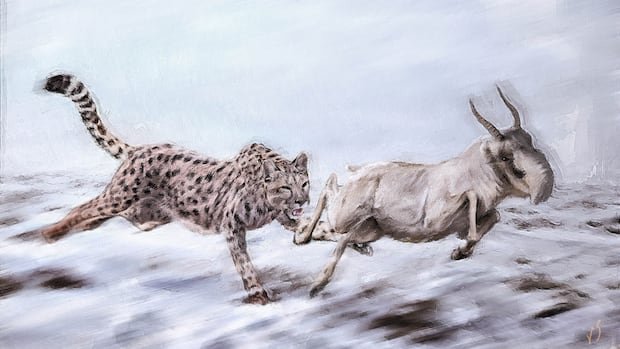

A recent discovery in northern Yukon has upended previous assumptions about ancient bones found in the Bluefish Caves and a local mine site. Initially believed to be from ice-age pumas or cougars, DNA analysis conducted by the University of California revealed a surprising twist. The testing, carried out by Molly Cassatt-Johnstone, a former lab technician, challenged the initial classification of the bones. Yukon paleontologist Grant Zazula was stunned to learn that the specimens, thought to be cougars, were actually cheetahs.
The identification of a Yukon Miracinonyx, also known as the extinct American cheetah, marked a significant breakthrough. Cassatt-Johnstone, now the lead author of a published paper in Current Biology, has shed new light on the ice-age cat’s dietary habits and habitat. The researchers’ findings have unveiled a captivating narrative surrounding the ancient cheetah population in the Yukon.
Historically, experts believed that the American cheetahs, resembling modern-day cheetahs with their long limbs and slender physique, would have hunted pronghorns on grassy plains. However, the discovery of these creatures in the Arctic tundra baffled scientists. Beringia, the land that once connected Asia and North America, including parts of present-day Russia, Alaska, and the Yukon, served as the unexpected habitat for these elusive cats.
To unravel the mystery of how Miracinonyx thrived in such an environment, researchers employed stable isotope analysis. This technique, commonly used in forensic investigations, provided critical insights into the cheetahs’ diet, behavior, and geographical movements. Surprisingly, the study revealed that Yukon cheetahs predominantly subsisted on fish, a behavior rarely observed in felines, past or present.
The revelation that these ancient cheetahs relied heavily on salmon for sustenance has intrigued experts like Julie Meachen, a specialist in Late Pleistocene mammalian carnivores. This unique dietary preference in the Yukon, distinct from their counterparts in midcontinental North America, underscores the adaptive nature of these creatures in a competitive environment teeming with formidable predators.
Furthermore, genetic analysis unveiled that Miracinonyx shared a closer genetic relationship with North American pumas than African cheetahs. The study also highlighted the low genetic diversity within the cheetah population, suggesting potential challenges in adaptation and survival. Zazula advocates for rebranding the northern population of these felines from ‘American Cheetah’ to ‘Yukon Cheetah,’ emphasizing the importance of continued exploration and discovery in paleontology.