
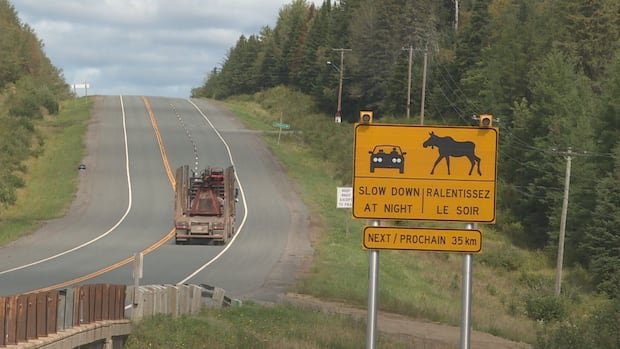

On a dim Saturday night in the latter part of August, the Chaleur Lightning ice hockey team had recently finished an exhibition match against the Miramichi Timberwolves and had boarded their team bus for the journey back to Bathurst. Assistant coach Alex Ouellet recalled a moment when the driver suddenly gasped, signaling trouble. “It happened within the first five minutes of the drive,” Ouellet recounted. “I glanced up and saw a figure ahead of us, followed by a loud bang.”
The team bus had a collision with a moose on the highway, but fortunately, Ouellet mentioned that everyone on board, including the players and coaches, escaped unharmed, except for the driver, who sustained minor scratches. Like many residents of New Brunswick who have encountered or narrowly missed large animals on the road, Ouellet admitted it was an unforgettable experience for him and the team. “Every time I travel those roads, I’ll definitely be thinking about it, especially during evening hours,” he shared.
Coincidentally, during the same week, the province announced the addition of two new wildlife crossings in that very highway section. These structures, known as wildlife tunnels, are part of the province’s efforts to prevent moose from straying onto roadways. Transportation Minister Chuck Chiasson explained that the placement of these measures is based on collision data gathered by law enforcement to identify high-risk areas needing attention.
Currently, both sides of 331 kilometers of New Brunswick highways are shielded by wildlife fencing. However, Chiasson emphasized that endless fencing cannot entirely impede wildlife movement, thus the use of wildlife crossings. New Brunswick boasts 82 wildlife crossings, including two recent installations on Route 8 between Miramichi and Bathurst. These tunnels, exceeding four meters in height and width, consist of 11 prefabricated concrete segments.
The effectiveness of these tunnels was studied over 15 years ago when they were first introduced on Route 7. Wildlife ecologist Graham Forbes, who led the research, noted that various animals, not just large mammals, utilized the tunnels. Despite the Department of Transportation not observing a significant decline in collisions due to the tunnels, efforts are ongoing to enhance road safety, including clearing brush for better visibility.
Looking ahead, Ouellet expressed hope for additional fencing in the area, acknowledging the limitations in preventing every collision. “You try to make the best of a tough situation and implement the most preventive measures possible,” he concluded.